
TL;DR
The best all-around pick is the HALO BassiNest Swivel Sleeper 4.0 Signature at about $280, because bedside swivel access is the one feature that matters most in the first 6 weeks. If motion is your problem, there are three tiers: Graco Sense2Snooze around $250, UPPAbaby Soma at $600, SNOO at $1,695. The cheapest safe pick is the Dream On Me Karley under $100. Every bassinet here meets AAP flat-surface safe sleep rules.
Latchly is a participant in the Amazon Associates Program. We earn a small commission when you buy through our links, at no extra cost to you. We only recommend products we’d give to a friend.
You are 32 weeks pregnant, standing in front of a wall of bassinets or scrolling through 40 different listings. Every one of them has 5 stars and a paragraph explaining why it is the best one on the page. The prices run from $70 to $1,700, and nothing you can see tells you what that extra $1,600 is actually buying you.
So here are the 8 best bassinets for 2026, ranked by what actually matters in the first 6 months: safe sleep compliance, bedside access, c-section recovery, motion for a baby who will not settle, and whether the price makes any sense at all.
What Actually Matters in a Bassinet
Skip the marketing. These six things separate a bassinet that works in your bedroom from one that ends up in the garage.
Flat, firm sleep surface. This is the one thing you cannot compromise on, because the AAP requires a flat, firm mattress for infant sleep, and the inclined sleepers that used to fill this category were recalled and pulled from shelves. Every bassinet below meets the flat-surface rule.
Height that matches your bed. If you want bedside access, the top of the bassinet mattress should sit within about 2 inches of your own mattress height, which is why most bassinets give you somewhere between 5 and 9 height positions to work with.
Weight limit and the mobility limit. Most top out at 20 or 25 pounds, or at the point where baby can push up on hands and knees. Check both numbers before you buy, because big babies sometimes hit the weight limit months before they hit the milestone.
C-section accessibility. If you are recovering from a c-section, leaning over a fixed side is not something you can safely do for about 6 weeks. Look for a swivel or a wall that drops. Our postpartum recovery timeline covers what those first weeks actually feel like.
Motion, if your baby needs it. Some bassinets rock, sway, or run a motor that responds to crying. Genuinely useful for some babies, completely ignored by others. This is the feature you are paying for when the price jumps past $250.
Portability. If the bassinet is moving between bedroom and living room every day, weight and folding matter more than any feature on the box.
Comparison Table
| Bassinet | Type | Best For | Weight Limit | Price |
|---|---|---|---|---|
| HALO BassiNest 4.0 Signature | Bedside swivel | C-section recovery, bedside access | 20 lb | About $280 |
| SNOO Smart Sleeper | Responsive motion | Colic, very short sleep stretches | 25 lb | $1,695 buy, $159/mo rent |
| Chicco LullaGo Anywhere | Portable | Budget, small spaces, travel | 20 lb | About $110 to $150 |
| Graco Sense2Snooze | Cry-detection motion | Motion assist on a budget | 20 lb | About $250 |
| UPPAbaby Soma | Responsive motion | Smart motion under the SNOO price | 25 lb | About $600 |
| Nuna DEMI Bassinet + Stand | Bassinet + pram | Design, doubles as a stroller bassinet | 20 lb | About $500 |
| BabyBjörn Cradle | Gentle rocking, no motor | Small rooms, moving room to room | 18 lb | About $300 to $350 |
| Dream On Me Karley | Basic bedside sleeper | Tightest budget, backup location | 20 lb | About $70 to $100 |
The 8 Best Bassinets of 2026, Ranked
1. HALO BassiNest Swivel Sleeper 4.0 Signature

The best all-around pick. The BassiNest has been the L&D nurse recommendation for years, and the 4.0 Signature is the current version (HALO retired the Premiere line). It swivels a full 360 degrees on a single post, so you can spin baby over your bed without standing up, and the side wall lowers with a light push so you can reach in without leaning. Height adjusts to match your mattress, mesh runs along all four walls for airflow and visibility, and there is no motor, no app, and no subscription to quietly fail on you at 3am.
If you want more, HALO sells a 4.0 Air with a breathable mesh sleep pad and a Connected 3.0 with built-in AutoSoothe motion. The plain Signature is the one most families should buy.
Best for: C-section recovery, back pain, or anyone who simply wants the easiest possible bedside access in the first 6 weeks. Skip if: You want automatic motion or sound. Weight limit: 20 pounds or when baby can push up Price: About $280
2. SNOO Smart Sleeper (Happiest Baby)

The one people argue about. SNOO is either the reason a family survived the fourth trimester or a very expensive place to set a baby down, and which one you get depends on your baby. It listens for crying and answers with rocking and white noise that step up in intensity until she settles. The included sleep sack has wings that clip to the sides, which keeps her on her back and stops rolling. That wing swaddle is the only genuine safety feature any smart bassinet in this list adds.
The price is where most of the argument happens, so here are the actual numbers: $1,695 new, $1,195 for a certified pre-loved unit, or $159 a month to rent, plus a reconditioning fee and a refundable deposit on the rental. Rent it for a single month before you commit to anything, because if your baby turns out to ignore the motion entirely, you are out one month instead of $1,695.
Best for: Colicky babies, short sleep stretches, or a second baby in a household that is already running on empty. If you are in the thick of it, colic and the witching hour is the companion read. Skip if: Budget is tight, or your baby already sleeps in decent stretches, because no amount of rocking will settle a baby who is actually hungry. Weight limit: 25 pounds, about 6 months, or when baby can push up Price: $1,695 to buy, $1,195 pre-loved, $159 a month to rent
3. Chicco LullaGo Anywhere Portable Bassinet

The budget pick that gives up nothing on safety. Around $110 to $150 depending on the fabric, and it does the core job properly. You get a sturdy frame, a flat mattress, mesh sides for airflow, and a fold that goes into a car trunk or a closet, with no motor, no lights, and no app anywhere in the picture. Chicco also sells LE and SE versions of the same bassinet with different fabrics, so compare them on price rather than on the letters after the name.
At 15 pounds it is the one on this list you will actually carry from bedroom to living room twice a day without resenting it.
Best for: Tight budgets, small apartments, travel, and second babies when you already know what you actually use. Skip if: You want swivel bedside access or motion. Weight limit: 20 pounds or when baby can push up Price: About $110 to $150
4. Graco Sense2Snooze Bassinet
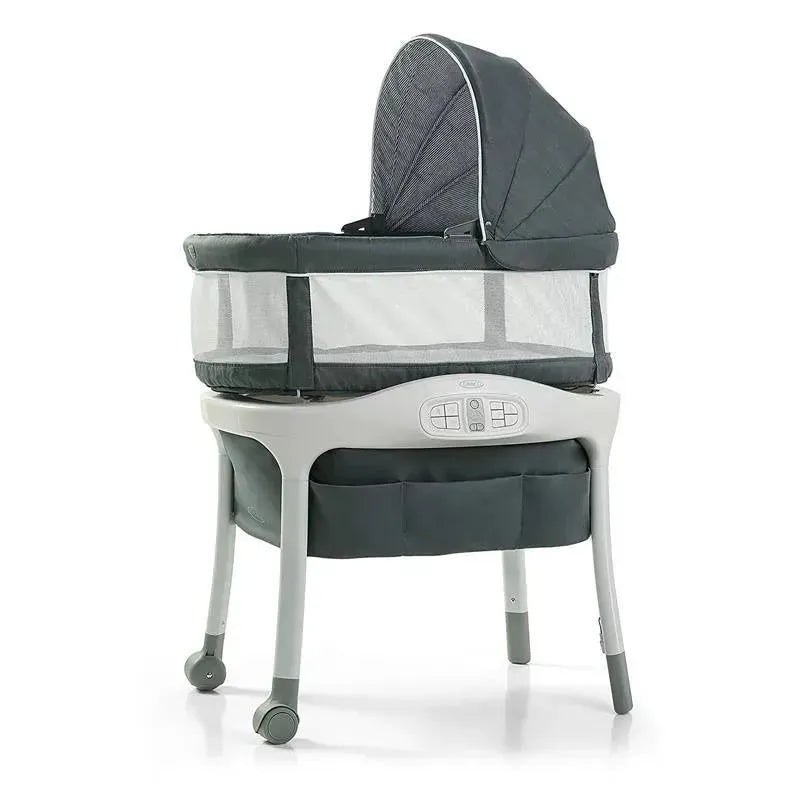
Responsive motion at a quarter of the SNOO price. A microphone in the base picks up crying and starts head-to-toe motion, vibration, and sound without you touching anything. You get three motion speeds, two vibration levels, white noise, 10 songs, and 10 sounds, and you can save the combination that works so you are not hunting for it half asleep. The parent controls dim for night use, the canopy reverses to block light, and the mattress pad comes off and goes in the wash.
The response here is fixed rather than escalating, and there is no wing swaddle, which is most of why it costs a quarter of what the SNOO does. What it does give you is the cheapest honest way to find out whether your baby is a motion baby at all, before you spend real money on the question. Price swings hard by retailer and color, from around $230 up past $400 at specialty stores, so shop it around. Graco’s newer SmartSense bassinet is the same idea in a different shell.
Best for: Testing whether motion helps your baby before you spend SNOO money. Skip if: You want the SNOO’s specific features, or your baby has already shown she does not care about rocking. Weight limit: 20 pounds or when baby can push up Price: About $250, and it moves
Track every feed without the spreadsheet
Latchly times each side, logs pumps, and shows you the patterns. Free to start.
5. UPPAbaby Soma Smart Bassinet
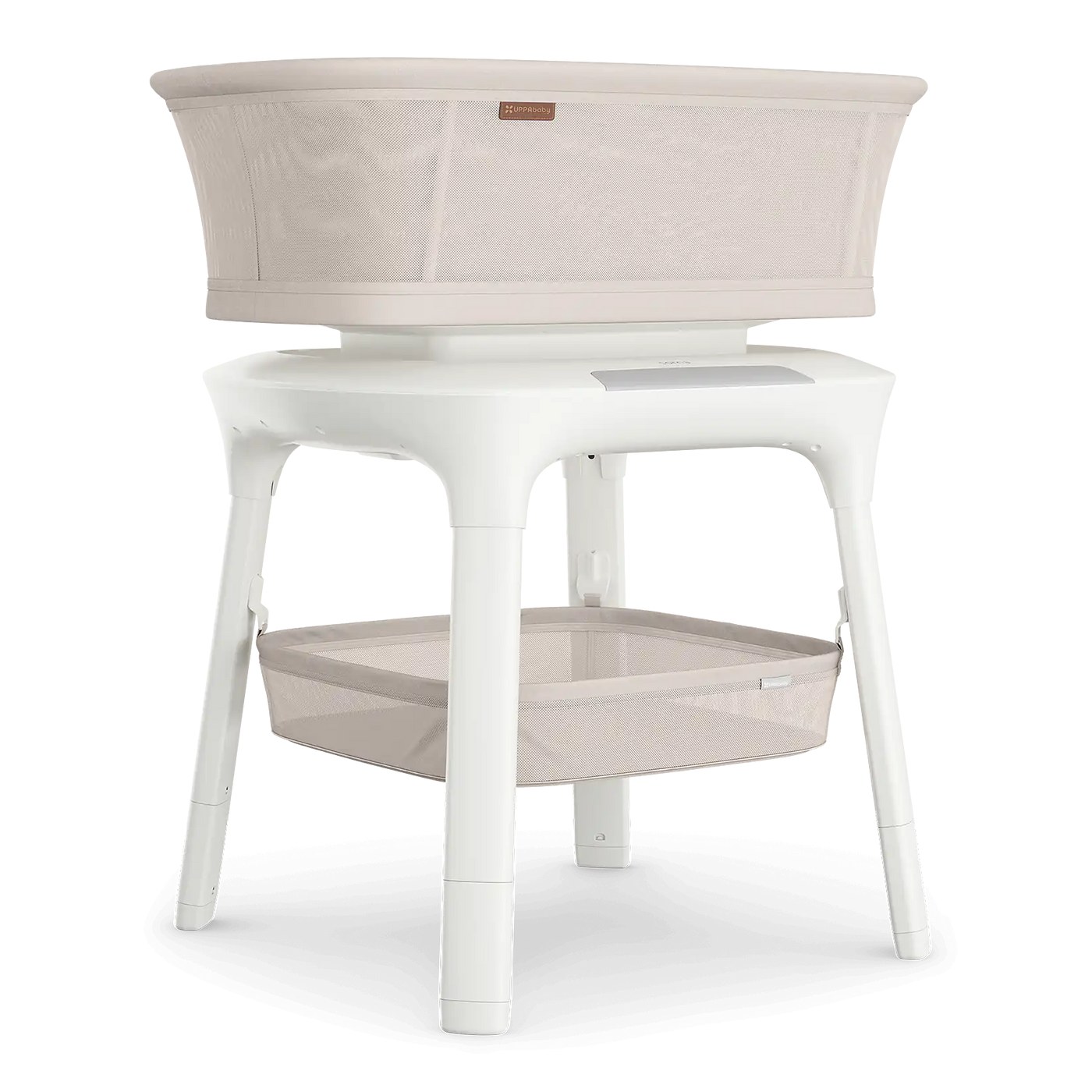
The middle rung of the smart-bassinet ladder. UPPAbaby’s Soma is the newest serious challenger to the SNOO and sits at $600, roughly a third of the price. Five motion speeds and a set of different motions, adjustable sounds, and a claimed 400-plus combinations, which mostly means you can keep trying things until one works. It runs 8 hours on a cycle, so it covers the whole night. The mattress is breathable mesh and machine washable, which matters more than it sounds like it does at 2am. Bluetooth means you can change the setting from your phone without walking in and waking her.
The honest catch: it weighs 30 pounds, so this is a bassinet that lives in one room.
Best for: Families who want responsive motion and cannot justify $1,695, and anyone who wants to change settings without opening the bedroom door. Skip if: You need to move the bassinet around the house. Weight limit: 25 pounds or when baby can push up Price: About $600
6. Nuna DEMI Series Bassinet + Stand

Buy this if it is doing two jobs. The DEMI bassinet clicks onto Nuna’s DEMI stroller frame for walks and naps out of the house, and onto its own stand for bedside sleep at home. That double duty is the whole argument for it, because as a standalone bassinet at $500 it is beautiful and otherwise unremarkable, while as a pram bassinet you also sleep the baby in overnight, it quietly replaces two separate purchases.
Worth knowing before you commit: a bassinet that gets carried outside gets dirty, and you will be washing the fabric more than you would a bassinet that never leaves the bedroom.
Best for: Families already buying into the Nuna stroller system, or anyone who wants one bassinet instead of a bassinet plus a stroller carrycot. Skip if: You are not buying the matching stroller, because without the second job the math stops working. Weight limit: 20 pounds or when baby can push up Price: About $500
7. BabyBjörn Cradle
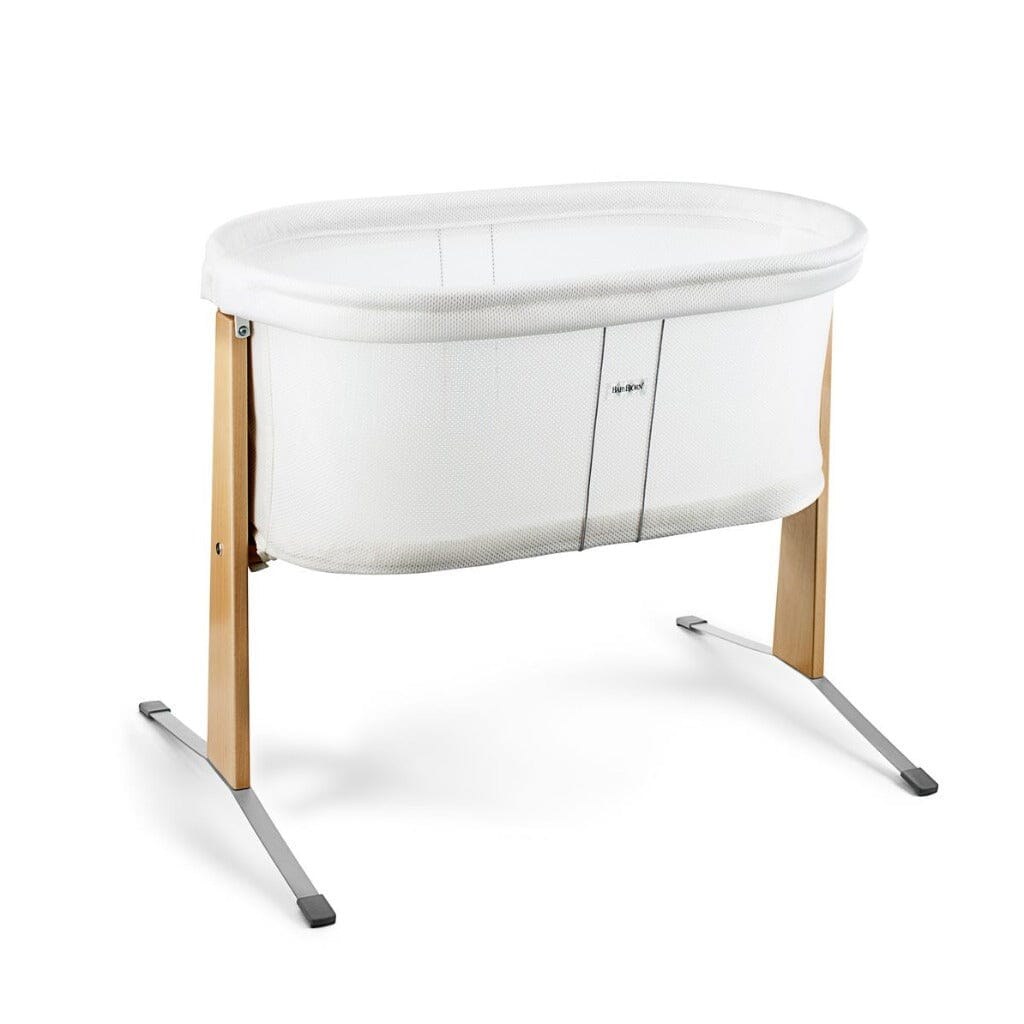
The one that rocks without a motor. The whole cradle is suspended so baby’s own movement sets it gently swaying, and you can start it with a hand and let it run down on its own. Mesh on all four sides means airflow even if she rolls her face right up against it. At 13 pounds it is the lightest real bassinet here, and there is no cord, so it goes wherever you are.
The trade-off is size and lifespan, since it is rated to 18 pounds and roughly 6 months and the sleep area runs smaller than everything else on this list, which means long babies outgrow it early.
Best for: Small bedrooms, moving from room to room, and anyone who wants motion without electronics. Skip if: You have a long or heavy baby, or you want one bassinet to carry you past the 6-month mark. Weight limit: 18 pounds or about 6 months Price: About $300 to $350
8. Dream On Me Karley Bassinet

The cheapest safe pick. Under $100, and it still delivers a flat firm surface, JPMA and ASTM certification, a drop side for bedside access, a double mesh canopy, wheels, and a storage basket underneath. It folds for storage or the trunk. What you give up is refinement: the fabric and hardware feel like a $75 product, because they are.
Plenty of families buy this as the second bassinet, the one that lives at grandparents’ house or in the living room, so nobody is carrying the good one up and down stairs.
Best for: The tightest budgets, or a second sleep spot at another location. Skip if: This is your only bassinet and you want it to feel nice for 6 months. Weight limit: 20 pounds or when baby can push up Price: About $70 to $100
How to Choose
Match the bassinet to the situation you are actually in:
- Recovering from a c-section? HALO BassiNest 4.0 Signature, because swivel access is the entire reason this category exists.
- Colicky baby or 45-minute sleep stretches? Start with the Graco Sense2Snooze at $250 to find out whether motion helps at all, and if it does, step up to the UPPAbaby Soma or rent a SNOO for a month.
- Budget under $150? Chicco LullaGo Anywhere, or the Dream On Me Karley if under $100 is the ceiling.
- Small bedroom, or moving the bassinet daily? BabyBjörn Cradle at 13 pounds, or the Chicco at 15.
- Already buying a Nuna stroller? Nuna DEMI Bassinet + Stand, so one bassinet covers both jobs.
- Want the strongest safe-sleep feature money can buy? SNOO, for the wing swaddle. It is the only one that keeps baby on her back mechanically.
Bassinets to Skip
- Any inclined sleeper. Rock ‘n Play, any wedge-based sleeper, and anything marketed as a “lounger” you can sleep a baby in. The AAP requires flat firm surfaces, so recalled or not, an incline is not a sleep surface.
- In-bed co-sleepers used as a sleep space. These are not AAP-approved for sleep. Room-share with a bassinet next to the bed, do not put a lounger in the bed.
- Vintage or antique bassinets. They photograph beautifully and may also come with lead paint, unsafe slat spacing, and no modern safety certification of any kind.
- Generic bassinets from off-brand sellers. No JPMA or ASTM mark means nobody has confirmed the sleep surface is flat and firm.
- Bassinets with padding, bumpers, or a pillow-top mattress. All of it goes against AAP guidance, so press the mattress with your hand, and if it dents under light pressure, it is too soft to sleep on.
Setting Up the Bassinet Safely
- Room-share, do not bed-share. The AAP recommends baby sleeps in your room but not in your bed for at least the first 6 months, and a bedside bassinet is exactly the setup that recommendation is describing.
- Leave a gap between bassinet and bed. Unless your model is designed to attach to the bed frame, in which case follow the manufacturer’s instructions exactly.
- Nothing in the bassinet but baby and a fitted sheet. No blankets, no toys, no pillows, no bumpers. If she needs warmth, use a swaddle or a sleep sack instead of a blanket.
- Firm mattress, fitted sheet, nothing added. No topper, no extra padding for softness.
- Room temperature around 68 to 72°F. Cooler is safer.
- On her back, every sleep. Day and night, until she can roll both ways on her own, usually 4 to 6 months.
If you are also setting up the monitoring layer, best baby monitors covers the video and breathing-tracking options that pair with a bassinet.
When to Transition Out of the Bassinet
- Weight limit reached. Usually 20 or 25 pounds, and 18 pounds on the BabyBjörn Cradle.
- She can push up on hands and knees. Usually 3 to 6 months, sometimes sooner.
- She is rolling. Rolling inside a small bassinet is a real risk, because the sides sit close and there is no room for her to reset her own position.
- She is nearly touching both ends lying down. Time for a crib.
Most families make the move somewhere between 3 and 6 months. If you are working out what sleep should look like at that point, newborn sleep patterns has the ages and stages, wake windows by age has the schedule chart, and night feeding survival covers the part nobody warns you about.
The Thing I Wish I’d Known
The bassinet is not the thing that decides whether your baby sleeps. Some babies sleep in a $70 bassinet from day one. Some babies do not sleep in a $1,695 one. You cannot tell which you have until she is here, and no amount of research at 32 weeks will tell you sooner.
So buy for the things you can already predict, because you do know whether you are having a c-section, you know how big your bedroom is, and you know what your budget will stand. Buy for those three, get the flat firm surface and the bedside access, and leave the whole motion question until after you have met her.
And if you end up returning it in week three and buying something else, that is just what happens when a real baby shows up and rewrites the plan you made at 32 weeks. Every one of us has a piece of baby gear in a closet that seemed completely obvious at the time.
Start with a safe flat surface next to your bed, because that covers the part that actually matters for her. Everything past that is comfort, and comfort is something you can buy later, once you know which kind of it she needs.
Frequently asked questions
Do I really need a bassinet, or can I use a crib from day one?
You can go straight to a crib, but most families use a bassinet for the first 3 to 6 months because it fits in your bedroom. The AAP recommends room-sharing (not bed-sharing) for at least the first 6 months, and most cribs do not fit next to an adult bed. A bassinet solves the room-sharing logistics.
How long can a baby use a bassinet?
Most bassinets are rated to 20 or 25 pounds, or until baby can push up on hands and knees, whichever comes first. That is usually 3 to 6 months, sometimes earlier for big babies. Check both limits for your specific model. Rolling over is the signal to move to a crib.
Is the SNOO worth the price?
For most families, no. The SNOO is $1,695 to buy, $1,195 certified pre-loved, or $159 a month to rent, and it works by using motion and sound that respond to baby’s crying. Families with a colicky baby or very short sleep stretches are the ones who tend to say it paid for itself. Most families do fine with a $150 to $300 bassinet. Rent first if you can.
Do bassinets need to be flat?
Yes. The AAP requires flat, firm sleep surfaces for infants under 12 months. Inclined sleepers (Rock ‘n Play and similar) were recalled after infant deaths and are no longer sold. Every bassinet in this roundup meets flat-surface requirements.
What about second-hand or hand-me-down bassinets?
Check the model against CPSC recall lists first. Only accept one that has not been recalled, still has all its parts and original manual, and looks structurally sound. Skip anything more than 5 years old, since safety standards have changed. Never accept an inclined sleeper.
Are smart bassinets safer than regular ones?
A smart bassinet is a regular bassinet with a motor and sensors added on top, so the safety floor is the same one every bassinet has to clear. The one genuine safety difference in this category is the SNOO’s wing swaddle, which clips to the sides and keeps baby on her back. Everything else a smart bassinet does is a sleep convenience, and every bassinet in this list meets the same flat-surface standard.