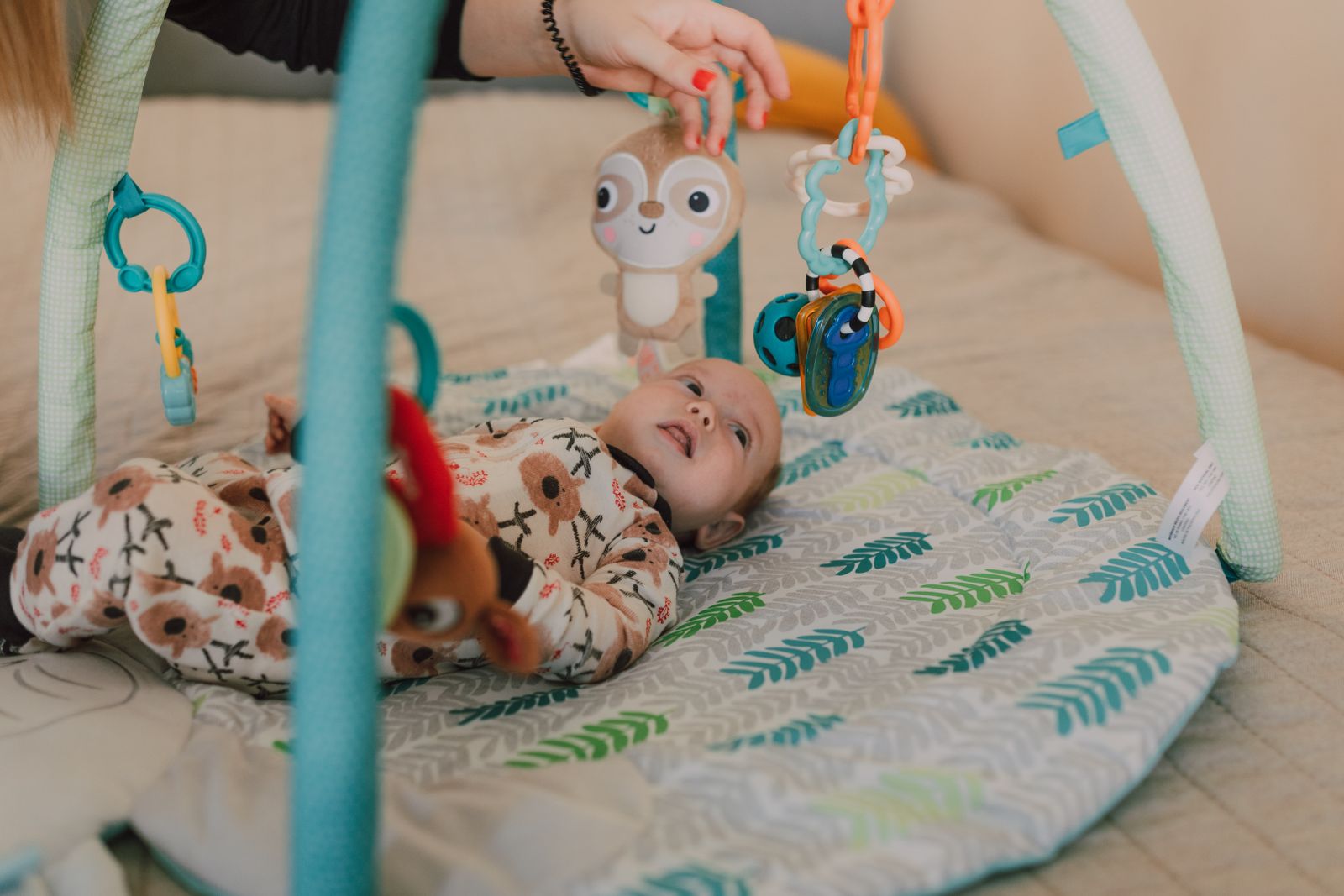
TL;DR
Wake windows are the time between one sleep and the next. Newborn windows are 30 to 60 minutes. By 12 months they stretch to 3 to 4 hours. The shortest window is between waking up in the morning and the first nap. The longest is between the last nap and bedtime. Wake windows are guidelines, not rules. Watch baby's tired cues too.
Your baby is 3 months old. She woke up at 6:30am. It is now 8:45am. She is either yawning and rubbing her eyes, or laughing at the ceiling and kicking her legs. You have no idea if it is nap time or too early.
First, the part that will feel familiar. You are trying to reverse-engineer a nap schedule from an Instagram chart, and every “expert” account gives different numbers. One says 90 minutes at 3 months. Another says 120. Another says “watch your baby, not the clock.” You want the clock AND you want to watch your baby. Both.
Here is what wake windows actually are, the real numbers by age, and how to read your baby’s tired cues so the clock and the baby are pointing at the same nap time.
What a Wake Window Actually Is
A wake window is the amount of time your baby is awake between one sleep and the next. It starts when you take her out of the crib (or she wakes fully) and ends when you put her back in for the next nap or bedtime.

Important distinction: the wake window ends when you put baby DOWN, not when she falls asleep. If it takes her 15 minutes to fall asleep, that time is part of the wind-down, not the wake window. And if your baby will only fall asleep when held, the put-down itself is the hard part, not the timing. Building 15 minutes of routine into the end of the window is what protects the fall-asleep transition. And if the put-down got harder right after your baby came out of the swaddle, our guide on when to stop swaddling covers the arms-out transition.
Wake windows exist because babies have a much smaller “sleep pressure” tank than adults. When they are up too long, their brain over-produces cortisol trying to keep them awake, and the next nap becomes a fight. When they are put down too early, they are not tired enough to fall asleep and the nap becomes a fight. The wake window is the sweet spot in between.
The Real Wake Windows by Age
These ranges are the pediatric-sleep-consensus numbers. They are ranges, not exact hits. Your baby might be at the top of the range in a growth spurt and the bottom the next week.
| Age | Wake window range | Number of naps |
|---|---|---|
| 0 to 4 weeks | 30 to 60 minutes | 4 to 6 naps |
| 4 to 12 weeks | 60 to 90 minutes | 4 to 5 naps |
| 3 to 4 months | 75 to 120 minutes | 3 to 4 naps |
| 5 to 7 months | 2 to 3 hours | 2 to 3 naps |
| 7 to 10 months | 2.5 to 3.5 hours | 2 naps |
| 11 to 14 months | 3 to 4 hours | 1 to 2 naps |
| 15 to 18 months | 4 to 6 hours | 1 nap |
0 to 4 weeks: 30 to 60 minutes
This is the survival window. Newborns can not stay awake more than about an hour without getting overtired. Most feed, have a diaper change, look around for 10 minutes, and are ready for sleep again. If you are getting cluster feeds in the evening, that is normal too. Cluster feeding covers what those marathon evening sessions actually mean.
Do not force wake time on a newborn. If she is sleepy after a feed, let her sleep. This is not the age to build long play windows.
4 to 12 weeks: 60 to 90 minutes
The window starts to stretch a little. She can handle 30 to 45 minutes of actual awake time (not counting feed time) before needing to go back down. You will start to see more alert eye contact and short play windows, which is the best time for a few minutes of tummy time.
By 12 weeks, most babies have consolidated their day into 4 to 5 more-predictable naps. But sleep is still shaggy, and the 4-month sleep regression is coming.
3 to 4 months: 75 to 120 minutes
The window becomes usable for planning. This is when parents can actually start to loosely schedule naps around wake windows. First wake window (morning) tends to be at the short end (75 to 90 minutes). Last wake window (before bedtime) tends to be at the long end (2 hours).
This is also the 4-month sleep regression window, so wake windows may get thrown off temporarily. Protect them anyway. Coming out of the regression is faster with wake windows respected.
5 to 7 months: 2 to 3 hours
Naps drop to 3 (usually). Morning nap around 90 minutes after wake up. Midday nap around 2.5 hours after morning nap ends. Afternoon nap around 2 hours after midday nap ends. Bedtime about 2.5 hours after the last nap ends.
At 6 months, some babies naturally drop the third nap and shift to a 2-nap schedule. Others hold on to 3 naps until 8 months. Both are normal.
Solids may start in this window. If you are also introducing food, starting solids has the readiness checklist.
7 to 10 months: 2.5 to 3.5 hours
Two-nap schedule. Morning nap around 2.5 hours after wake up (typically 9 or 9:30am). Afternoon nap around 3 hours after morning nap ends (typically 1 or 1:30pm). Bedtime about 3.5 hours after afternoon nap ends (typically 7 or 7:30pm).
If naps drop shorter than 45 minutes, look at wake windows first. Overtired babies take shorter naps.
11 to 14 months: 3 to 4 hours
One or two naps. Around 12 months, most babies transition from 2 naps to 1. The transition is bumpy. You will spend 4 to 6 weeks alternating between 1-nap and 2-nap days as baby adjusts.
When you move to 1 nap, aim for it to start around 12:30 or 1pm and last 90 minutes to 2 hours. Bedtime shifts earlier temporarily (6:30 or 7pm) to compensate for less total daytime sleep.
15 to 18 months: 4 to 6 hours
One nap, more clock-based. Wake windows still exist, but toddlers can handle more variation without falling apart. The schedule becomes: wake by 7am, one nap starting around 12:30pm and lasting 90 minutes to 2.5 hours, bedtime by 7:30pm.
Track every feed without the spreadsheet
Latchly times each side, logs pumps, and shows you the patterns. Free to start.
Why the First Wake Window Is Shortest
Look at the ranges again. At every age, the first wake window (from morning wake-up to first nap) is at the short end of the range, and the last wake window (from last nap to bedtime) is at the long end.
Here is why:
- Morning: After a long night of sleep, baby’s sleep pressure is low. She wakes rested but does not have enough tank capacity to stay awake as long as later in the day. She is ready to nap again sooner.
- Bedtime: The whole day’s stimulation has built up sleep pressure. Baby needs a longer wake window before bed to burn off the last bit of energy, then drops hard.
This is why “same wake window all day” schedules do not work. The morning wake window is naturally shorter. Force baby to stay awake for a 3-hour morning window at 6 months and she will be overtired and refuse the nap.
A working example schedule at 6 months:
- 7:00am wake
- 9:15am nap (wake window: 2 hours 15 minutes)
- 10:30am wake
- 1:00pm nap (wake window: 2 hours 30 minutes)
- 2:45pm wake
- 6:00pm bedtime (wake window: 3 hours 15 minutes)
Short → medium → long. That is the natural shape.
The Tired Cues That Matter
Wake windows are guidelines. Tired cues are the real-time data. Your baby will tell you before the clock does if you know what to watch for. Most of the early cues are things you can spot on a monitor before she ever cries, which buys you the 5 minutes that keep her from going overtired. Here are 8 baby monitors ranked on night vision and lag.
Early tired cues (put her down NOW): - Staring off, glazed eyes - Slowing down, less engaged with toys - Rubbing eyes, pulling ears - Sucking on fingers or a pacifier more intently - Long yawns
Late tired cues (baby is overtired): - Red eyebrows or red rims around the eyes - Arching, back-bending, thrashing - Sudden hyperactivity or “silly” laughing - Refusing to be put down - Hard, forceful crying
Aim to catch early cues, not late ones. If you see late cues, you missed the window and the next nap will be a fight. Do it anyway. Shorten the following wake window by 20 to 30 minutes to reset.

A smooth put-down is easier when the bassinet is right next to your bed, because you are lowering her a foot instead of carrying her across a room and waking her on the way. If you are still choosing one, here are the 8 best bassinets for newborns, ranked by bedside access first.
Common Wake Window Problems
1. Baby fights the nap. Try 15 minutes shorter first. Overtiredness fights sleep. If shorter does not fix it, try 15 minutes longer next time. Undertired babies also fight sleep because there is not enough sleep pressure to drop into a nap. If both fail, check for something else: teething, illness, a poop that has not happened yet, or a room that is too bright or too warm.
2. Naps are only 30 to 45 minutes long. That is one sleep cycle. Baby is waking between cycles because she can not connect them yet. This is normal until about 5 months. After that, short naps often mean wake windows were too long (overtiredness prevents deep-sleep consolidation) or too short (baby was not tired enough to enter deep sleep). Fix the wake window first. If short naps continue for 3+ weeks with well-timed wake windows, it might be a sleep-consolidation phase and will pass.
3. Baby is up before 6am every day. Early rising is usually caused by (in order): too-late bedtime (overtiredness rebounds at 4am), too-long last wake window, room not dark enough at 5am, or a nap that was too long in the late afternoon. Fix bedtime first. An overtired baby wakes earlier, not later. Move bedtime 30 minutes earlier for a week and see what happens.
4. Bedtime is a fight. Almost always the last wake window was too long. Try pulling bedtime 20 to 30 minutes earlier. Counterintuitive but it usually works.
When to Ignore Wake Windows
- Newborn phase. Feed on demand, sleep when sleepy. Wake windows are so short at this age that they are mostly not worth planning.
- Illness. Sick babies need more sleep. Let them nap when they want.
- Growth spurts. Growth spurts in babies run baby’s hunger up and sleep out of whack. Ride it out.
- Sleep regressions. 4-month sleep regression throws everything off. Wake windows still matter but do not stress if a nap is short.
- Big schedule changes. Travel, daylight saving time, a new caregiver. Baby needs a few days to adjust.
- Nap transitions. Dropping from 3 to 2 naps or 2 to 1. Expect a bumpy 2 to 4 weeks.
When to Call Your Pediatrician
Sleep problems are common and usually normal. Call if:
- Baby is younger than 3 months and consistently sleeping less than 12 hours total per 24 hours
- Baby is older than 6 months and consistently sleeping less than 10 hours per 24 hours
- Baby snores loudly or has pauses in breathing during sleep
- Baby’s sleep changes suddenly without a clear cause (regression, teething, illness) and does not resolve in 2 weeks
- You suspect silent reflux or colic is disrupting sleep
- Sleep deprivation is affecting your mental health. Baby blues vs postpartum depression has the signs.
The Thing I Wish I’d Known

Wake windows are a tool. Not a law. Not a magic formula. Not a substitute for reading your own baby.
The first month I tried to run a wake-window schedule for my baby, I was checking a timer every 3 minutes and stressing myself out worse than not knowing what I was doing. What actually worked was learning the general shape of the day (short first window, longer last window), watching for the yawn, and moving through the day with a rough plan and a lot of flexibility. Once your baby is old enough, wake windows also pair with any sleep training method you choose, since a well-timed put-down makes every approach smoother.
Your baby’s wake windows will shift week by week. Growth spurts stretch them. Illness shortens them. A great day of activity might extend them by 15 minutes. A rough night might collapse them.
Trust the chart to give you the shape. Trust your baby’s cues to give you the timing. And trust yourself to notice when neither is right and it is time to just hold her and let the nap happen wherever it happens.
The chart is the starting line. She is the whole race.
Frequently asked questions
What is a wake window?
A wake window is the time between when your baby wakes up from one sleep and goes down for the next. It starts when baby’s feet come out of the crib and ends when they go back in. Not when baby falls asleep, but when you put them down.
What are the wake windows by age?
0 to 4 weeks: 30 to 60 minutes. 4 to 12 weeks: 60 to 90 minutes. 3 to 4 months: 75 to 120 minutes. 5 to 7 months: 2 to 3 hours. 7 to 10 months: 2.5 to 3.5 hours. 11 to 14 months: 3 to 4 hours. Ranges, not exact numbers.
Why is my baby's first wake window shorter than the rest?
That’s normal. The first wake window of the day is almost always the shortest. Sleep pressure is lowest in the morning after a long night, so babies are ready to nap again sooner. The longest wake window is the last one before bedtime.
What if my baby fights the nap even when the wake window is right?
Try shifting 15 minutes shorter first (baby might be at the end of the range and overtired). If that fails, try 15 minutes longer (baby might be at the start of the range and not tired yet). Also check for tired cues. Wake windows are guidelines, not the only signal.
How do I know if my baby is overtired?
Overtired babies fight sleep harder, take shorter naps, wake more often at night, and get progressively fussier through the afternoon. Signs at the moment: red eyebrows, glazed eyes, arching, hyperactivity, forced laughter. If your baby is overtired, shorten the next wake window by 20 to 30 minutes to reset.
When should I stop using wake windows?
Around 15 to 18 months, most babies transition to a clock-based nap schedule (usually one afternoon nap around noon or 1pm). Wake windows still exist but they matter less because the schedule is more predictable. Toddlers can handle more flexibility.