![Baby Blues vs Postpartum Depression [2-Week Rule]](/blog/images/posts/baby-blues-vs-ppd/hero.jpg)
TL;DR
Baby blues hits about 3 in 4 new moms in the first two weeks, then lifts on its own. Postpartum depression looks similar at first but lasts longer than two weeks, gets heavier, and needs real help. The 2-week rule is your line: if the heaviness is still there past day 14, or it's getting worse, call your doctor today.
You had the baby. You’re home. You love this tiny person so much it hurts. And you can’t stop crying.
If you’re reading this at 2am, wondering if what you feel is normal or something more, you’re in the right place. A quick honest answer: most likely this is the baby blues and it will lift. But there’s a line between baby blues and postpartum depression, and knowing where that line is matters. This post walks you through both, the 2-week rule that separates them, the exact signs to watch for, and what to say when you need help.
First, the part that will feel familiar. Everyone told you the newborn days would be hard. Nobody told you you’d sob folding a onesie at 4pm on day 5.
What is the baby blues?
The baby blues is a short stretch of mood swings, tearfulness, and overwhelm that hits most new moms in the first two weeks after birth. It affects up to 3 in 4 postpartum women. It’s caused by a steep drop in pregnancy hormones, massive sleep loss, and the emotional size of what just happened to your body and your life.
The key word is short. Baby blues typically starts 2-3 days postpartum, peaks around day 5, and lifts on its own by day 14. It doesn’t need medication. It doesn’t mean something is wrong with you. It means your body just made a human and your hormones are finding a new floor.
Common baby blues signs: - Crying easily over small things (a song, a diaper rash, a dropped bottle) - Mood swings inside the same hour - Feeling overwhelmed, then fine, then overwhelmed again - Trouble sleeping even when the baby sleeps - Mild anxiety about the baby - Feeling tender, raw, or weepy without a clear reason
If that list sounds like you and you’re less than two weeks postpartum, this is almost certainly normal. It’s survivable. It passes.
What is postpartum depression?
Postpartum depression (PPD) is a mood disorder that affects up to 1 in 7 new moms. It looks a lot like baby blues at the start, but it stays. It gets heavier instead of lighter. It interferes with your ability to eat, sleep, care for yourself, or bond with your baby.
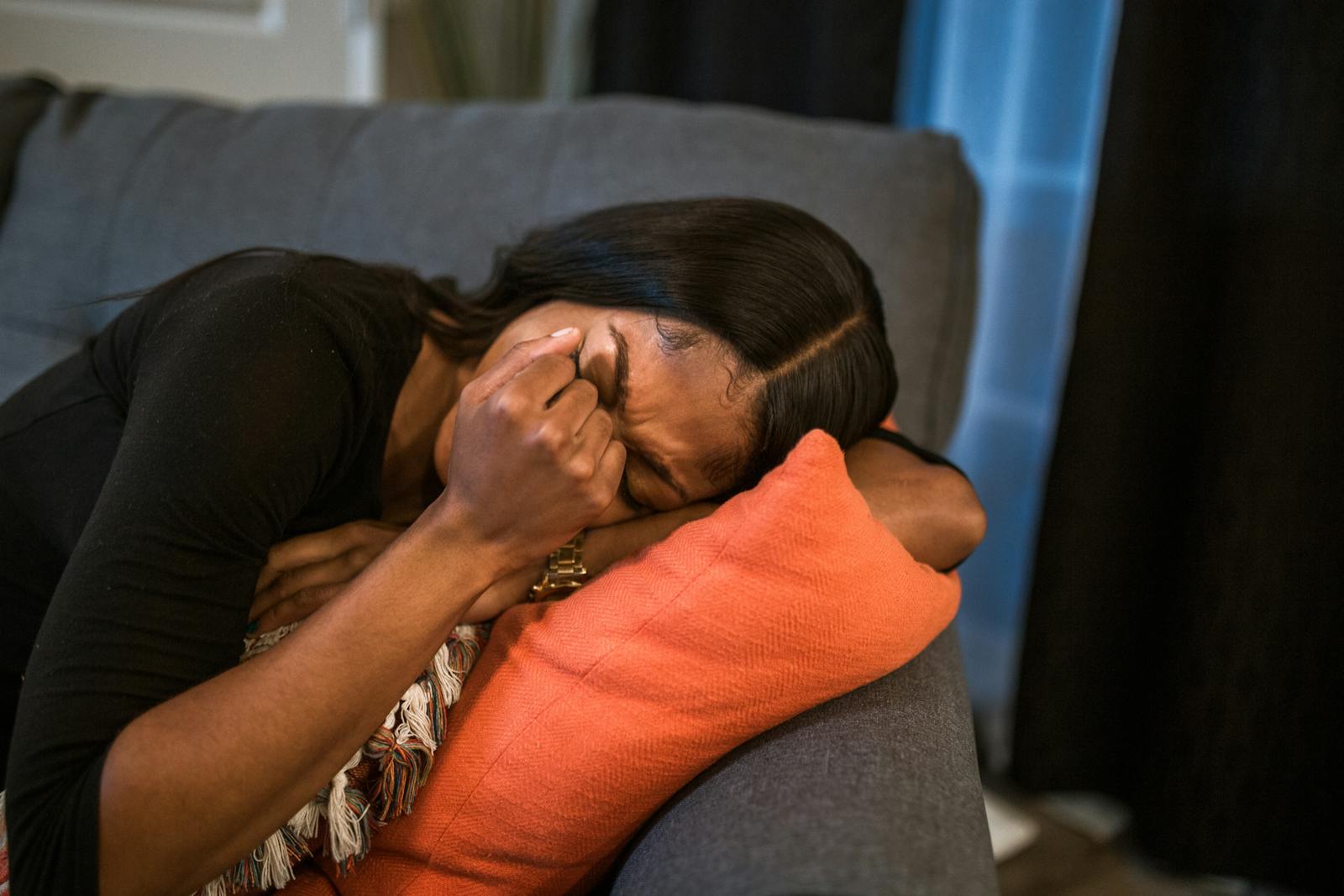
PPD can start any time in the first year after birth. Most cases show up within the first 3 months, but late onset is real. It can also show up at weaning, when your period returns while breastfeeding (hormone shifts can amplify PMS for the first few cycles back), or when you go back to work. Risk factors include a history of depression or anxiety, a traumatic birth, NICU time, a colicky baby or relentless witching hour, weak family support, or a personal or family history of PPD.
Postpartum depression is not a weakness. It’s not a parenting failure. It’s a medical condition and it responds very well to treatment.
The 2-week rule (this is the line)
Here is the single most useful thing to know. If your low mood, anxiety, or crying is still heavy past day 14, or it’s getting worse instead of better, it’s probably not baby blues anymore. Call your doctor.
That’s the rule. Two weeks. Day 14.
Baby blues lifts on its own. Postpartum depression does not. Every week you wait makes treatment longer. Every week you wait is another week of not feeling like yourself, and you deserve to feel like yourself.
If you’re past two weeks and something is still off, that’s your signal to pick up the phone.
Baby blues vs postpartum depression: 7 key differences
Here’s how the two actually separate when you line them up.
1. Duration. Baby blues lasts under two weeks. Postpartum depression lasts more than two weeks and often months if untreated.
2. Severity. Baby blues is uncomfortable but manageable. PPD feels heavy, dark, and bigger than you can carry.
3. Function. With baby blues, you can still take care of yourself and your baby. With PPD, basic tasks like eating, showering, or feeding the baby feel impossible.
4. Bonding. Baby blues doesn’t stop you from loving your baby. PPD can make you feel numb, disconnected, or like you’re going through the motions with a stranger.
5. Sleep. Baby blues wrecks your sleep because the baby does. PPD can make you unable to sleep even when the baby is sleeping, or make you want to sleep all the time and still feel tired.
6. Thoughts. Baby blues makes you weepy. PPD can bring thoughts of worthlessness, hopelessness, that the baby would be better off without you, or that you don’t deserve this baby.
7. Trajectory. Baby blues gets better over the two weeks. PPD gets worse.

If three or more of these sound like you past the 2-week mark, call your doctor this week.
The 7 signs that mean call your doctor today, not next week
These are red flags. Don’t wait two weeks if you see any of these.
- Thoughts of hurting yourself or the baby, even fleeting ones
- Feeling nothing when you hold your baby, or feeling like you’re watching yourself from outside
- Scary intrusive thoughts that won’t leave (images of harm, fire, drops, accidents)
- Panic attacks with a racing heart, chest tightness, or feeling like you can’t breathe
- Not eating or not sleeping at all for more than 24 hours, even when you have the chance
- Hearing or seeing things other people aren’t (possible postpartum psychosis, rare but an emergency)
- A feeling that the baby would be better off without you
If any of those are happening, you are not broken, you are not a bad mom, and you are not alone. These are symptoms, not truths. Call your OB, your primary care doctor, or 988 (Suicide and Crisis Lifeline). Call 1-833-TLC-MAMA (free, 24/7 Maternal Mental Health Hotline) if you want someone who specializes in exactly this. If you’re in danger right now, go to the ER or call 911.
What to do right now if you think it might be PPD
You don’t have to wait for your 6-week checkup. Mental health is on the same recovery clock as the rest of your body, and that clock keeps ticking long past 6 weeks. Our postpartum recovery timeline lays out exactly what’s healing when, and mood is one of the slowest layers, so a heaviness that’s still there at week 6 (or week 12) is something to address, not push through. Here is the exact path.
Track every feed without the spreadsheet
Latchly times each side, logs pumps, and shows you the patterns. Free to start.
Call your OB or midwife. Leave a message that says, “I think I might have postpartum depression. I need to be seen this week.” Most practices have a same-week slot for this. You do not need to have it “figured out” before you call.
Call your baby’s pediatrician. Pediatricians screen for maternal depression at well-baby visits in most US states and they have referral networks. If your OB is hard to reach, your pediatrician can be the faster door.
Download the Edinburgh Postnatal Depression Scale. It’s a free 10-question self-test used in almost every clinical setting. A score of 10 or higher is the standard flag for follow-up. This is not a diagnosis, it’s a starting point you can show your doctor.
Tell one person in your life. Your partner, a friend, your mom. Not to ask them to fix it. Just to not carry it alone. Saying the words out loud (even “I think something is wrong”) is a real step. This is one of the items on our postpartum essentials checklist for a reason: a trusted person on speed-dial is a postpartum essential, not a luxury. (The physical-recovery side has its own list in the 12-product postpartum recovery kit, brand-named picks for the first 6 weeks.)
Lower the bar on everything else. If you can feed the baby and keep yourself safe, that’s the whole list. The house can stay messy. Meals can be toast. This week is about survival, not performance. Our postpartum self-care guide reframes the bar entirely: drinking a glass of water, eating one real meal, and stepping outside for two minutes are not “below baseline,” they are the baseline.
Get out of the house once. Not as a fix, just as a data point. A 10-minute walk, a cafe, a friend’s porch. PPD thrives on isolation, and most early postpartum avoidance is about the breastfeeding logistics, not the depression itself. If the dread is specifically about nursing in front of strangers, our breastfeeding in public guide walks through the 6 steps that take that first outing from terrifying to forgettable. If the dread doesn’t lift even when the breastfeeding piece is solved, that’s a clue this is more than logistics.
Sleep deprivation is a huge driver of both baby blues and PPD. If you haven’t already, read our piece on night feeding survival for ways to cut the 3am loop, and the first 14 days of breastfeeding if you’re still in the early stretch trying to figure out what’s even normal. If your mood dips right around the 4-month sleep regression, you’re not imagining the connection. Broken sleep at the exact moment your body finally expected a full night is one of the hardest hits on your mental health, which is why the 4-month well-baby visit screens for PPD.
What to say when you don’t know what to say
Words are hard when you’re foggy. Here are scripts you can copy.
To your OB: “I’m [X] weeks postpartum and my mood has not improved. I’m crying daily, I can’t sleep, and I don’t feel like myself. I think I need to be evaluated for postpartum depression.”
To your partner: “I don’t think I’m okay. I know it’s scary to hear. I need you to help me get help.”
To your mom or a friend: “I need you to come sit with me for an hour. I don’t need you to fix it. I just need to not be alone right now.”
To 988 or 1-833-TLC-MAMA: “I’m a new mom, I’m [X] weeks postpartum, and I’m not doing well.”
That’s it. You don’t need more words than that.
Things that are NOT postpartum depression (but feel awful)
A few things commonly get mistaken for PPD and they’re worth naming.
Postpartum anxiety is its own thing. It’s intrusive worry (baby breathing, SIDS, dropping the baby, something going wrong) that doesn’t stop. It affects up to 20% of new moms and is often underdiagnosed because “anxiety in new moms” is written off as normal. If this is you, tell your doctor. It’s treatable.
Postpartum rage is a surge of anger that feels out of proportion, often aimed at your partner. It’s a recognized symptom of both PPD and postpartum anxiety. It can also show up on its own from sleep deprivation and the hormone crash. There’s a full guide to postpartum rage with the signs, why it happens, and how to cool a rage wave in the moment. It doesn’t make you a bad person.
Thyroid shifts after birth can mimic depression (low thyroid = fatigue, low mood, weight changes, brain fog). Ask your doctor for a thyroid panel alongside any mental health screening. The same postpartum thyroiditis also shows up as heavy hair shedding that won’t stop, so if both are happening at once, that one lab is worth pushing for.
Iron deficiency from birth blood loss also mimics depression. A simple CBC and ferritin test catches it. This is why it’s worth getting labs when you see your doctor, not just a mental health questionnaire.
Cluster feeding burnout at weeks 2-3 and week 6 can feel like PPD when it’s actually just an exhausted week that will pass. If you’re caught in one, our cluster feeding guide explains why it spikes and when it breaks.
When to call your pediatrician about YOU
Yes, your pediatrician. Most US pediatricians screen moms at the 2-week, 2-month, 4-month, and 6-month well-baby visits using the Edinburgh Scale. If you’re between visits:
- If your mood has been low for more than 2 weeks
- If you’re having scary intrusive thoughts
- If you’re not sleeping even when you could
- If you’re not eating
- If you don’t feel bonded with the baby and it’s bothering you
- If you feel like you’re not a safe caregiver
None of these mean CPS. None of these mean they take your baby. They mean your pediatrician helps you find a therapist or an OB who handles maternal mental health. That’s it.

The thing I wish I’d known
If you are sitting there reading this and wondering if the way you feel is normal, the fact that you’re asking the question is already meaningful. Moms with severe depression often can’t get here. You can. That’s a good sign.
But also. If something is off, please don’t wait for it to get bad enough to “deserve” help. You deserve help now. You deserve to feel like yourself. Your baby deserves a mom who isn’t drowning. And treatment works. Really well. Faster than you think.
Two weeks is the line. Past that, make the call. You are not overreacting. You are not weak. You are a person who just did an enormous thing and your brain chemistry is catching up.
Whatever this is, you don’t have to carry it alone.
Frequently asked questions
Can baby blues turn into postpartum depression?
Not exactly, but untreated baby blues that doesn’t lift by week 2, plus risk factors like a history of depression or a hard birth, can slide into postpartum depression. The 2-week rule is what separates them. If you’re still crying daily at week 3, it’s not baby blues anymore.
When does postpartum depression usually start?
Any time in the first year. Most cases show up within the first 3 months, but it can start weeks or months later, especially around weaning, the return of your period, or going back to work. Late onset is real and just as treatable.
Is it normal to cry every day after having a baby?
In the first two weeks, yes. Daily crying from hormone shifts, sleep loss, and overwhelm is baby blues and it’s extremely common. Past week 2, daily crying is a sign to call your doctor. It’s not a character flaw, it’s a signal.
Can you have postpartum depression and still love your baby?
Yes. Most moms with postpartum depression love their babies deeply. The guilt is often about not feeling joy, not a lack of love. Depression dulls your feelings, it doesn’t erase them. Getting treatment brings the joy back.
How is postpartum depression treated?
Talk therapy, medication, or both. Many antidepressants are compatible with breastfeeding. Your doctor may also test your thyroid and iron since both can mimic depression. Treatment usually starts working within 2-6 weeks.
What if I'm scared to tell anyone?
You can tell your OB, your pediatrician, or a lactation consultant. Pediatricians now screen moms at well-baby visits in most US states. You can also call or text 988 (Suicide and Crisis Lifeline) or 1-833-TLC-MAMA (the national Maternal Mental Health Hotline, free and 24/7).