![Baby Feeding Schedule by Age [Newborn to 1 Year]](/blog/images/posts/feeding-schedule-by-age/hero.jpg)
TL;DR
Newborns feed 8-12 times a day, every 2-3 hours. By 3 months it's 6-8 feeds. By 6 months it's 4-6 milk feeds plus solids. By 12 months you're at 3 meals and 2 snacks. The number of feeds drops every few months. Watch the baby, not the clock.
It’s 2pm. You just fed the baby an hour ago. Now they’re rooting around like they haven’t eaten in a week. Is this normal? Did they not get enough? Am I doing this wrong?
You came here for a number. Something clean. “Feed every 3 hours.” A clock you can set your day around so the chaos finally has edges.
I’ll give you the numbers. But the real answer is messier and easier than the chart suggests, and once you see it, the 2pm panic goes away.
What a Baby Feeding Schedule Actually Is
A feeding schedule is the loose pattern of how often your baby eats across 24 hours. The number of feeds, the size of each feed, and the gap between them all change every few months as your baby grows.

Here is the part most charts skip. The schedule doesn’t come from a book. It emerges from your baby. Your job in the first few months is to watch hunger cues and respond. The rhythm settles itself somewhere around month 2-3. Trying to lock a 3-week-old into a strict 4-hour schedule fights biology, and it usually backfires on supply.
Why the Schedule Keeps Changing
A newborn’s stomach holds about a teaspoon on day 1. By day 3, it’s the size of a walnut. By 4 weeks, an egg. By 6 months, a small fist. As that capacity grows, baby takes more per feed and feeds less often.
Three things drive the change month to month:
- Stomach capacity. Bigger stomach = bigger feeds = longer gaps.
- Sleep patterns. As night sleep stretches grow, night feeds drop. Our newborn sleep patterns guide shows how this lines up.
- Solids. Around 6 months, solid food starts replacing some milk volume.
That’s why a 2-week-old eats 10 times a day and a 9-month-old eats 4. Same baby, different stage.
Feeding Schedule by Age: Month by Month
Real ranges below. Your baby may be on the high end or the low end and still be totally fine. If diapers and weight are on track, you’re hitting the schedule for your baby.
Newborn (0-2 weeks)
- Feeds per day: 8-12
- Frequency: every 2-3 hours, day and night (count from start of feed to start of next)
- Per breast feed: 10-20 minutes per side, switching when baby slows down
- Per bottle feed: 0.5-2 oz on day 1, working up to 2-3 oz by week 2
- Night: wake baby if they go more than 4 hours
The first 14 days are about getting feeding established. Babies lose up to 7-10% of birth weight in the first few days and need to be back to birth weight by day 10-14. Frequent feeds drive that. Cluster feeding hours in the evening are normal and help your supply ramp up. The full week-by-week breakdown lives in our first 14 days of breastfeeding guide. One daily add-on that stays constant no matter how the schedule shifts: if you are nursing, start vitamin D drops for your breastfed baby in these first days.
Weeks 2-4
- Feeds per day: 8-10
- Frequency: every 2-3 hours during the day, sometimes one 3-4 hour stretch at night
- Per breast feed: 15-25 minutes total, often one side
- Per bottle feed: 2-4 oz
Mature milk has fully come in. Your supply is regulating. You may notice baby pulls off faster as they get more efficient. Around the 3-week growth spurt, expect a day or two of cluster feeding and shorter naps.
1-2 Months
- Feeds per day: 7-9
- Frequency: every 2.5-4 hours
- Per breast feed: 10-20 minutes total
- Per bottle feed: 3-5 oz
- Night: one 4-6 hour stretch, often the first stretch after bedtime
This is when a loose pattern starts to show up. Most babies aren’t on a strict clock yet, but you’ll notice the rhythm: morning feed, mid-morning feed, lunch feed, and so on. Don’t force it. Let it happen.
2-4 Months
- Feeds per day: 6-8
- Frequency: every 3-4 hours
- Per breast feed: 5-15 minutes total (efficient nursers can drain in 5)
- Per bottle feed: 4-6 oz
- Night: one or two night feeds, with a longer stretch in between
Total daily intake is around 24-32 oz of breast milk or formula. The 4-month sleep regression hits around now and can shake the pattern for a couple of weeks. That’s not a feeding problem. It’s a sleep cycle change.
4-6 Months
- Feeds per day: 5-7 milk feeds
- Frequency: every 3-4 hours
- Per bottle feed: 5-7 oz
- Solids: introduced around 6 months, 1-2 small servings (see the baby-led weaning first foods list for what to offer)
- Night: zero to one night feed for many babies
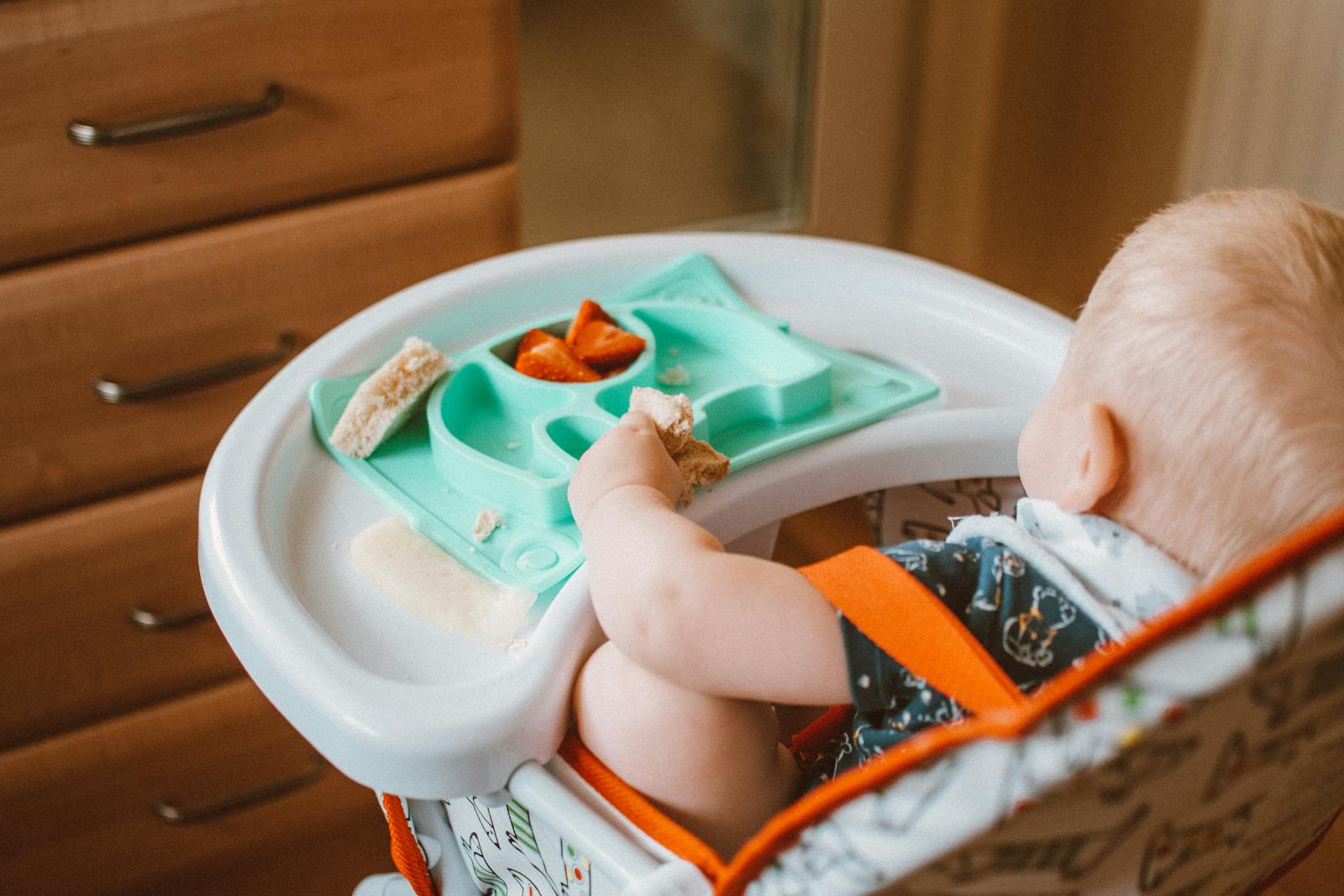
Around 6 months, you can start solids, once your baby is showing the readiness signs. Two important things to remember:
- Solids start small. A few teaspoons once or twice a day. Most calories still come from milk for the next 3-4 months.
- Milk first, then solids. Offer the milk feed, then offer solids about 30 minutes later. Solids should not replace milk feeds yet.
6-9 Months
- Feeds per day: 4-5 milk feeds + 2-3 solid meals
- Per bottle feed: 6-8 oz
- Solids: 2-3 meals plus a snack
- Night: most babies have dropped night feeds, though some still take one
Daily milk intake stays around 24-30 oz. Solids start carrying real calories. Texture progresses from purees to mashed to soft finger foods. This is also when teeth tend to arrive, and some babies start biting while breastfeeding. It’s a short teething phase, not a sign your baby is ready to wean.
9-12 Months
- Feeds per day: 3-4 milk feeds + 3 solid meals + 1-2 snacks
- Per bottle feed: 7-8 oz
- Solids: 3 meals plus snacks, mostly self-feeding
- Night: rare night feeds; mostly sleeping through
By 12 months, milk drops to about 20-24 oz a day as solids fill in. You’re transitioning toward a toddler eating pattern: 3 meals, 2 snacks, plus milk at certain times of day. If you’re nursing and ready to start cutting feeds, the step-down weaning method handles that shift one feed at a time without engorgement or a distraught baby.
Breastfed vs Formula-Fed: What’s Different
The number of feeds is similar. The clock is not.
- Breast milk digests in about 90 minutes. Formula takes 3-4 hours.
- Breastfed newborns often want to eat every 2-2.5 hours. Formula-fed newborns can stretch to 3-4 hours sooner.
- Bottle volumes are easier to track, but per-feed volume varies. A breastfed baby can take 2 oz at one feed and 5 oz at the next and total the same as a steady 3.5 oz bottle baby.
- You can’t underfeed a breastfed baby on demand. They self-regulate. Bottle-fed babies can be overfed if you push the bottle past their cues, so paced bottle feeding helps.
- Doing both is normal. Plenty of families land on a mix of breast and formula. Our combination feeding guide covers how to combo feed without tanking your supply.
If you’re pumping or doing a mix of breast and bottle, our pumping schedule guide walks through the 5 schedules that actually work for working and at-home moms.
Cluster Feeding and Growth Spurts Throw Off the Schedule
This is where every parent panics that something is wrong. It’s not. Babies have predictable growth spurts that crush the existing pattern for a day or two.
The big spurt windows:
- Days 7-10: the first big spurt
- Weeks 2-3: more frequent feeds, more fussiness
- Week 6: another bump
- Month 3: sleep changes, feeding changes
- Month 6: often around solids starting
During spurts, your baby will feed almost back to back for 6-8 hours, sleep terribly, and act inconsolable. The feeding is the message: their body is asking for more milk. If you’re nursing, your supply ramps up to meet the new demand within 24-48 hours. The full pattern lives in our baby growth spurts guide.
Track every feed without the spreadsheet
Latchly times each side, logs pumps, and shows you the patterns. Free to start.
Cluster feeding is the related cousin. Most babies cluster feed in the late afternoon or early evening, eating constantly for 2-4 hours, then taking a longer stretch of sleep after. It’s a feature, not a bug. The full breakdown of what cluster feeding is and how to survive it covers it.
Feeding Cues Beat the Clock Every Time
If you remember one thing from this whole post, make it this. Watch your baby, not the clock.
Hunger cues, in order of how loud they get:
- Stirring, lip smacking, opening and closing the mouth (early)
- Rooting, hands to mouth, sucking on fists (active)
- Squirming, fussing, head turning toward your chest (active)
- Crying (late)
Crying is a late cue. By the time baby is screaming, they’re upset and hard to latch. Catch the early cues and the feed goes smoother. Over time you stop watching the clock and start watching the baby.
How to Know the Feeds Are Working
This is where the worry actually gets answered. Not by counting minutes or ounces, but by counting output.

The two reliable signs:
- Wet diapers: 6 or more in 24 hours after day 5 (more on the day-by-day count in wet diapers newborn)
- Weight gain at well visits: following baby’s own curve
If those two are happening, the schedule is working. Period. Total breakdown lives in our guide on how to tell if baby is getting enough milk.
When to Call Your Pediatrician
Most schedule worries are normal. These are the ones that aren’t.
- Fewer than 6 wet diapers a day after day 5
- Baby hasn’t regained birth weight by day 14
- Baby is consistently refusing feeds for more than 8 hours
- Baby is lethargic, hard to wake, or not interested in eating
- Sudden drop in feeding volume that lasts more than 24 hours
- No weight gain or weight loss at a well visit
- Vomiting (not spit-up) after most feeds
- Signs of dehydration: sunken soft spot, dry mouth, no tears when crying
- For older babies (4+ months): refusing solids for weeks after they’ve started, or not gaining weight
Trust your gut. If something feels off, call. That’s exactly what the pediatrician’s office is for.
What About Night Feeds?
Night feeds drop in waves, not all at once.
- 0-3 months: 2-3 night feeds is typical
- 3-6 months: 1-2 night feeds, with one long stretch (often 5-7 hours)
- 6-9 months: 0-1 night feeds for most babies
- 9-12 months: sleeping through, with occasional regression nights
If night feeds are still hitting hard, our night feeding survival guide has the setup tricks (station, paced bottle for partner, dream feeds) that make the 3am wake-up easier.
A Quick Reset for the Next Time You Doubt the Schedule
When the 2pm panic hits, run this:
- Diapers: 6+ wet today?
- Cues: Was baby actually rooting, or just fussy from another cause (gas, tired, overstimulated)?
- Pattern: Have they been close to their usual rhythm this week?
- Last well visit: Pediatrician happy with weight?
If most are yes, the feed they want at hour 2 instead of hour 3 is just a feed they want. Offer it. Babies are not robots and an hour off the chart isn’t a problem.
The Thing I Wish I’d Known

The first time someone handed me a feeding chart, I tried to follow it like a recipe. Every 3 hours, 3 oz, switch sides at 15 minutes. I set timers. I logged feeds in an app. I called the pediatrician at 2am because we were 40 minutes off the plan.
It took me a week to realize the chart was a guide, not a contract.
The schedule comes from your baby. Not the chart. Not the app. Not the friend whose 8-week-old “sleeps 8 hours and eats every 4.” Your job is to feed when they ask, in the way that works for both of you, and to trust that the rhythm shows up around the 2-3 month mark.
If you’re feeding 8-12 times a day at 1 week, you are doing this right. If you’re feeding 6 times at 3 months, you are also doing this right. If you’re feeding 4 milk feeds plus 3 meals at 9 months, that is also right.
There is no perfect schedule. There is just your baby, asking for what they need, and you, learning to listen.
Save this post. Come back to it at every age stage. The numbers stay; the panic doesn’t.
Frequently asked questions
How often should a newborn eat?
Every 2-3 hours, day and night, for a total of 8-12 feeds in 24 hours. Wake them if they go more than 4 hours between feeds in the first 2 weeks.
What is a typical feeding schedule for a 3-month-old?
About 6-8 feeds a day, every 3-4 hours during the day, with one or two longer night stretches. Most 3-month-olds are taking 4-5 oz per bottle or feeding 5-15 minutes per side at the breast.
When can I stop feeding my baby at night?
Most babies can drop overnight feeds between 4 and 6 months once they’re gaining well and starting solids. Some hold onto one night feed until 9-12 months. Both are normal.
How much should a 6-month-old eat?
About 24-32 oz of breast milk or formula a day across 4-6 feeds, plus 1-2 small servings of solids. Solids are for practice and exposure at 6 months. Milk is still the main food.
Should I feed on a schedule or on demand?
On demand for the first 6-8 weeks. Babies show hunger cues (rooting, hands to mouth, fussing) before they cry. After 2-3 months, most babies settle into a loose 3-4 hour pattern on their own.
How do I know my baby is getting enough at each feed?
Count diapers, not minutes. 6+ wet diapers a day after day 5, weight gain at well visits, and stretches of contentment between feeds mean things are working.