
TL;DR
A C-section does not stop you from breastfeeding, but it can delay your milk by about a day and make the first 72 hours harder on your body. The fixes are skin to skin as soon as you can, a first feed or hand expression within the first hour or two, 8 to 12 feeds or expressions a day, pain meds taken on schedule, and positions that keep the baby off your incision. Call your doctor for a fever, an incision that leaks or opens, or a baby with too few diapers by day 4.
You just had major surgery, and now someone is handing you a baby and saying “go ahead and latch.” You can’t sit up without help. There’s an IV in one hand and a blood pressure cuff on the other arm. Your legs are still numb. And in the back of your mind is the thing you’ve read a dozen times: milk comes in later after a C-section. Here’s what I want you to know first. Breastfeeding after a C-section works. It just needs a different first 72 hours.
First, the part that will feel familiar: you’re lying flat, you can feel the baby rooting on your chest, and you have no idea how to get them to your breast without pulling on your incision. That moment is where this post starts.
Why breastfeeding after a C-section feels harder
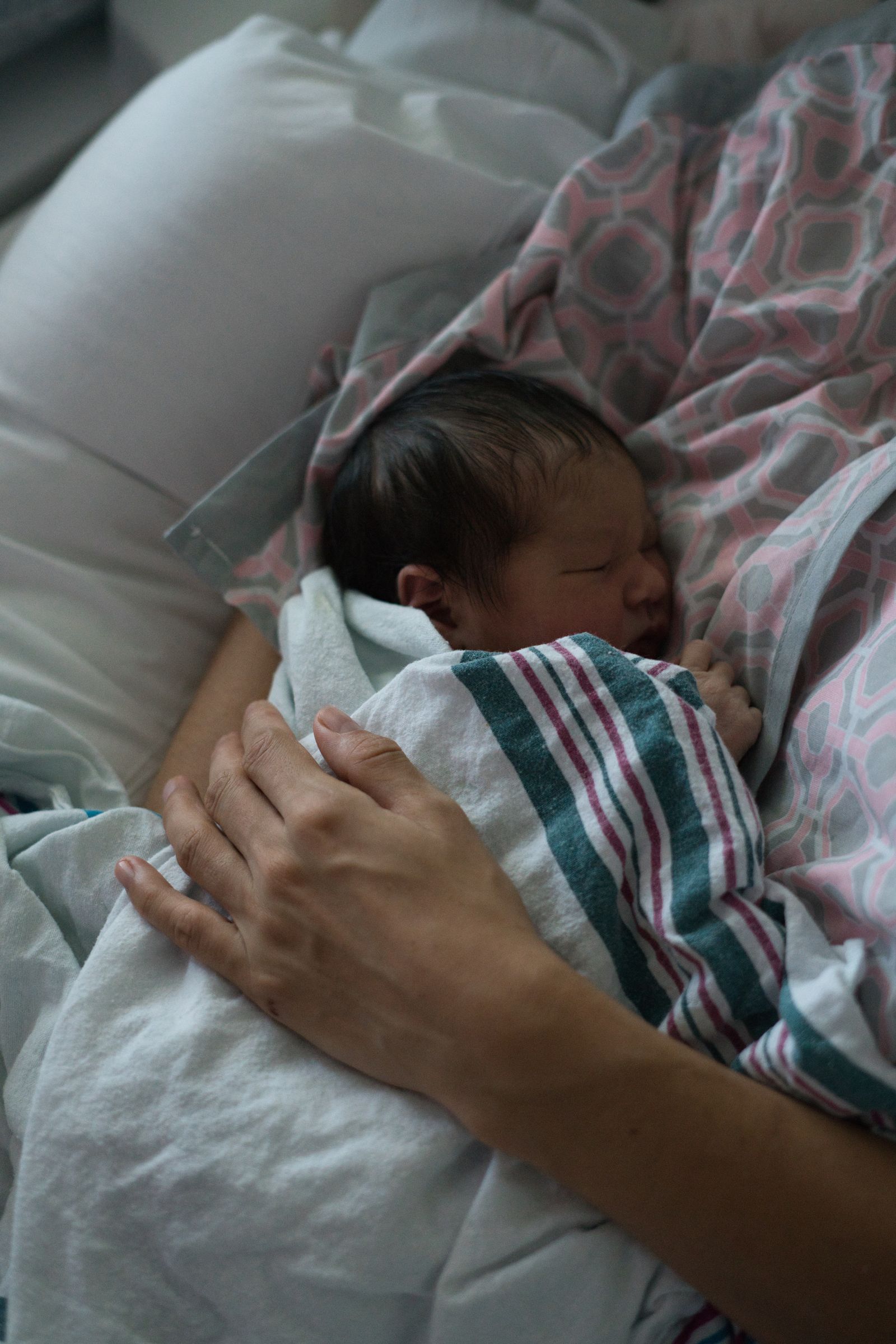
It isn’t you. It’s the setup. A C-section stacks 4 things against the early days of breastfeeding, and every one of them is fixable.
1. Your body got a different hormone signal. Milk making switches on when the placenta comes out, no matter how you give birth. But labor adds a surge of hormones that helps that switch flip faster. A planned C-section before labor skips that surge, which is one reason the full milk can take a day longer to arrive.
2. You and your baby may have been apart. Surgery, stitching, recovery room checks, a baby who needed a warmer. Every hour without a feed or an expression in the first day is an hour your breasts didn’t get the “make milk” message.
3. You can’t move. Getting the baby from the bassinet to your breast is a 2-person job for the first day or two. So feeds get delayed, and delayed feeds slow milk.
4. IV fluids puff up your breasts. Surgery means a lot of IV fluid. Some of it settles in breast tissue and makes the areola firm and swollen, which makes a deep latch harder in exactly the days you need it most.
None of these change how much milk you can make. They change how fast it starts. That’s the whole fight in the first 3 days, and you can win it.
When does milk come in after a C-section?
Most moms feel the full milk arrive between day 3 and day 5 after a C-section, which is about a day later than after a vaginal birth. Before that, you’re making colostrum. Colostrum is thick, yellow, and comes in tiny amounts, and that is by design. On day 1, your baby’s stomach holds about a teaspoon per feed. Colostrum covers that with room to spare.
So “my milk isn’t in yet” on day 2 is normal. It is not a sign your body failed. Your baby is being fed. The job on days 1 to 3 is to give your breasts the signal so the switch flips on time, or even early.
A delay past day 5 is called delayed onset, and it’s more common after a C-section, a long labor that ended in surgery, heavy blood loss, or a first baby. It’s also the point where you stop waiting and get a lactation consultant in the room. Not because it’s too late, but because it’s the moment extra help makes the biggest difference.
7 fixes when your milk is late

Here is what actually moves the timeline. Do as many as you can, starting as early as you can.
-
Ask for skin to skin in the operating room. If you and your baby are both stable, many hospitals will put the baby on your chest while they close. If not in the OR, then in recovery. Skin to skin triggers the hormones that start milk, calms the baby, and often leads to a self-latch while you’re still numb. Put it in your birth plan and say it out loud to the anesthesiologist. They’re the one standing by your head.
-
Get a first feed or a first expression in the first hour or two. If the baby latches, wonderful. If the baby is sleepy, or in the nursery, or you’re too shaky, hand express instead. A nurse can show you in 2 minutes. You’re not trying to fill a bottle. You’re trying to send the signal. Even a few drops of colostrum on a spoon or in a syringe counts, and the baby can be fed those drops.
-
Hand express after feeds, 8 times a day, until your milk is in. This is the step most C-section moms are never told. Hand expression in the first 3 days is tied to more milk at week 6. Cup your breast, press back toward your chest, compress, release. Collect what comes in a small cup or syringe and give it to the baby. If you have a hospital pump, use it too, but hand expression gets colostrum out better than a pump does in the first 2 days.
-
Feed or express 8 to 12 times in every 24 hours, and wake the baby to do it. C-section babies are often sleepy from the medications and the birth. A sleepy baby who goes 5 hours between feeds is the biggest reason milk comes in late. Set an alarm for 3 hours max between the start of one feed and the start of the next. Undress the baby to the diaper, do skin to skin, and switch sides when they drift off. Our guide to a baby who falls asleep while breastfeeding has more ways to keep a sleepy newborn eating. If you’re not sure the baby is actually swallowing, our guide to whether your baby is getting enough milk walks through what to listen and look for.
-
Take your pain medication on schedule, not when it gets bad. Pain keeps you still, and still is the enemy of supply. The standard combo is ibuprofen and acetaminophen around the clock, and both are safe for breastfeeding. More on this below. When you’re ahead of the pain, you can move, change position, and feed often.
-
Use positions that keep the baby off your incision. Football hold and side-lying are the two workhorses for the first 2 weeks, and I’ll walk through each one next. A firm pillow across your lap or belly matters more after a C-section than after any other birth. If you’re choosing one, our nursing pillow comparison covers which ones work when your incision is tender.
-
If the baby needs more, give your own colostrum first, and keep feeding at the breast. Sometimes a C-section baby loses more weight than the pediatrician likes, or has jaundice that needs more milk to clear. A top-up is not the end of breastfeeding. Ask for it in this order: your hand-expressed colostrum, then donor milk or formula, given by syringe, cup, or a slow paced bottle. And keep putting the baby to the breast first every time. The top-up feeds the baby. The breast builds the supply.
Get the appTrack every feed without the spreadsheet
Latchly times each side, logs pumps, and shows you the patterns. Free to start.
Positions that keep the baby off your incision
The rule is simple: nothing rests on your belly, and no feet point at your incision. Four positions do that well. For a full walkthrough of each one, see our guide to breastfeeding positions.
Football hold (clutch hold). Sit up with the bed raised. Tuck the baby under your arm on the side you’re feeding from, feet pointing behind you, head at your breast. Pillows under your arm bring the baby up to you so you’re not leaning down. This is the first position most C-section nurses teach because the baby never touches your middle.
Side-lying. Lie on your side with a pillow behind your back and one between your knees. Lay the baby on their side facing you, nose level with your nipple, and pull their hips in close. Tuck a rolled towel or small pillow along your belly so the baby’s legs can’t kick the incision. This is the night position. You don’t have to sit up, and you don’t have to lift anyone.
Laid-back with a pillow shield. Recline the bed to about 45 degrees, lay a firm pillow across your belly, and let the baby lie on top of the pillow, tummy down on you, so gravity holds them in place. Good for a baby who wants to self-latch and for days when sitting upright hurts.
Cross-cradle with a lap pillow. Once your incision is less tender, usually by the end of week 1, cross-cradle gives you the most control over the latch. Use a firm pillow on your lap so the baby’s body rests on the pillow, not on you. If the latch pinches, our latch guide shows the fix.
Pain medication and breastfeeding: what’s safe
Treating your pain well is part of feeding your baby. Here’s the short version of what your care team is likely to offer.
- Ibuprofen and acetaminophen are the first choices. Very little passes into milk. Most hospitals schedule both around the clock for the first few days. Take them.
- Spinal or epidural morphine given during surgery is a one-time dose and is considered compatible with breastfeeding.
- Oxycodone or hydrocodone for breakthrough pain are usually fine for a few days at the lowest dose that works. Watch the baby for extra sleepiness, limp feeding, or trouble waking. If you see that, tell your nurse.
- Codeine and tramadol are not recommended while breastfeeding. Some moms break codeine down very fast, and the baby can get too much. If you’re offered either one, ask for an alternative.
- Ask about everything else. Stool softeners, iron, and antibiotics are almost always fine. Your nurse or pharmacist can check anything in seconds, so ask instead of skipping a dose.
Here’s the part that surprised me. The medication was never the problem for breastfeeding. Skipping it was. The day I started taking the ibuprofen on time instead of waiting until I couldn’t stand was the day feeds stopped feeling like a fight.
Getting the baby to you without hurting yourself

For the first 2 or 3 days, you should not be the one lifting the baby out of the bassinet. That’s what the call button and your partner are for. A few things that help:
- Keep the bed raised so you’re never starting a feed flat. Sitting up from flat is the move that hurts most.
- Log roll to get up. Roll onto your side, drop your legs over the edge, push up with your arm. Never sit straight up from your back.
- Hug a pillow across your incision when you cough, laugh, or sneeze. It takes the sting out.
- Get a bassinet you don’t have to lean over. At home, a bedside bassinet with a swivel or drop side means you can slide the baby to you instead of lifting and twisting.
- Set up a feeding station at bed height. Water, snacks, phone, burp cloth, nipple cream. If it’s on the floor, it doesn’t exist for 2 weeks.
- Let the swelling go down. If your areola is firm from IV fluids and the baby can’t get a deep latch, press gently with your fingertips around the base of the nipple for a minute before latching. It pushes the fluid back and softens the area. Your nurse may call it reverse pressure softening.
You’ll feel like you’re doing it wrong because it takes 3 people and 5 pillows. That’s not wrong. That’s a C-section on day 2.
How to know it’s working
You can’t see what the baby took, so count what comes out. By day 1 you want 1 wet diaper. Day 2, 2. Day 3, 3. By day 5, you’re looking for 6 or more wet diapers a day and poop that has turned from black to green to yellow. If you want the day-by-day on the rest of the first 2 weeks, our guide to the first 14 days of breastfeeding lays it out.
A few other good signs: you hear swallows, your breasts feel fuller before a feed and softer after once your milk is in, and the baby settles after most feeds. Weight loss up to about 7 to 10 percent in the first days is common, and C-section babies can look like they lost a little more because IV fluids inflate their birth weight. Your pediatrician will tell you if it’s time for a top-up.
When to call your doctor
Call your OB or midwife the same day for:
- A fever of 100.4°F or higher.
- An incision that is red, hot, oozing, opening, or smells bad.
- Bleeding that soaks a pad in an hour, or large clots.
- Pain that is getting worse instead of better after day 3.
- Pain, swelling, or warmth in one calf.
Call 911 or go to the ER for: chest pain, trouble breathing, a sudden severe headache, or feeling faint.
Call your pediatrician or a lactation consultant for:
- Fewer wet diapers than the day of life on days 1 through 4, or fewer than 6 a day after day 5.
- No sign of fuller milk by day 5.
- A baby who won’t wake to feed, or who goes more than 4 hours between feeds in the first week.
- Yellow skin that is spreading, or poop that is still dark by day 5.
- A latch that hurts the whole feed or leaves your nipple pinched or bleeding.
If you can’t tell whether something is normal, ask. The nurses and lactation staff are there for exactly these questions, and the postpartum recovery timeline shows what else to expect in the weeks after surgery.
The thing I wish I’d known

The first 3 days after a C-section are a feeding problem and a logistics problem, and both are temporary. By the end of week 1, your milk is in, you can get out of bed on your own, and the football hold is second nature. By week 2 most C-section moms are feeding exactly like everyone else. The research backs this up: once breastfeeding is established, C-section moms nurse just as long as anyone.
So if your milk is late on day 3 and you’re hand expressing drops into a spoon while someone else changes the diaper, you are not behind. You’re doing the thing that brings the milk in. Give yourself the pain meds, the pillows, and the help.
Your next step is small. Put the baby skin to skin right now, press the call button, and ask the nurse to show you hand expression. That one move does more for your milk than anything you’ll read today.
Frequently asked questions
When does milk come in after a C-section?
Usually between day 3 and day 5, which is about a day later than after a vaginal birth. Until then your baby gets colostrum, which comes in teaspoon-sized amounts and is exactly what a newborn stomach can hold. Frequent feeds and hand expression bring the full milk in sooner. If nothing has changed by day 5, call a lactation consultant.
Is it harder to breastfeed after a C-section?
The first 3 days are harder because of pain, limited movement, IV lines, and a possible delay in milk. After that, C-section moms breastfeed just as well and just as long as anyone else. The early days need more help, more pillows, and more hand expression, not more worry.
Can I breastfeed right after a C-section?
Often yes. Many hospitals now do skin to skin in the operating room or recovery room, and a first feed within the first hour is possible if you and your baby are stable. If you’re separated, ask for a pump or start hand expressing within the first hour or two so your body gets the signal anyway.
What is the best breastfeeding position after a C-section?
Football hold and side-lying are the two most comfortable because they keep the baby’s weight off your incision. Laid-back nursing with a pillow across your belly works well too. Avoid any position where the baby’s feet can kick your incision.
Are C-section pain medications safe while breastfeeding?
Ibuprofen and acetaminophen are the first choices and are considered safe. Short courses of oxycodone or hydrocodone at the lowest dose are usually fine for a few days. Codeine and tramadol are not recommended while breastfeeding. Take your pain meds on schedule, because pain that keeps you from moving and feeding hurts your supply more than the medication does.
Does a C-section lower milk supply long term?
No. A C-section can delay the start of full milk, and early days with fewer feeds can slow things down, but it does not change how much milk you can make. Frequent, effective milk removal in the first 2 weeks sets your supply, and that is fully in reach after a C-section.