
TL;DR
Jaundice shows up in most newborns, and it's more common in breastfed babies. Early jaundice usually means your baby needs more milk, so the fix is more frequent, more effective feeds, not stopping. Later jaundice that lingers in a baby who is feeding and growing well is usually harmless breast milk jaundice. Call your pediatrician the same day for yellow skin in the first 24 hours, yellow that is spreading or deepening, a baby too sleepy to feed, too few diapers, or pale or chalky poop.
Your baby looks a little yellow, and now every diaper change turns into a skin check under the window light. Maybe a nurse mentioned bilirubin on the way out of the hospital. Maybe your mom said “that baby looks yellow” and now you can’t unsee it. Here’s the reassuring part: jaundice shows up in most newborns, it’s even more common in breastfed babies, and most of the time the fix is something you’re already doing. Feeding.
First, the part that will feel familiar: someone told you breastfeeding might be the cause, and you wondered if you should stop. Please don’t. In almost every case, breastfeeding more is how jaundice goes away.
What is newborn jaundice?
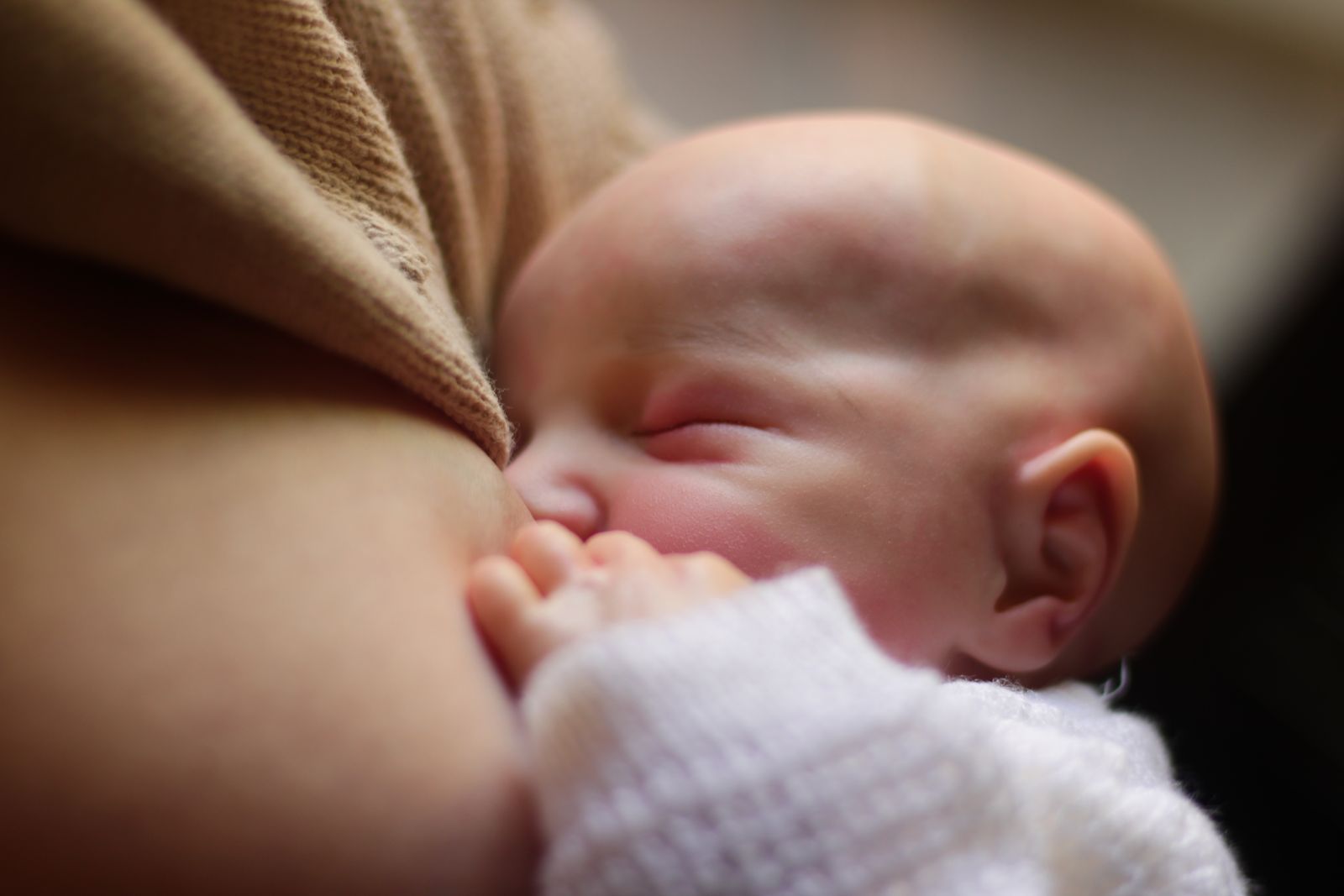
Jaundice is a yellow tint to the skin and the whites of the eyes, caused by a build-up of bilirubin. Bilirubin is a yellow substance your baby’s body makes when it breaks down old red blood cells. Newborns have lots of extra red blood cells from the womb, and their liver is still learning to process bilirubin quickly. So it builds up for a few days.
Your baby gets rid of bilirubin mostly through poop. That’s the key to this whole post. More milk in means more poop out, and more poop out means less bilirubin.
About 6 in 10 full-term babies get some jaundice. It usually shows up on day 2 or 3, peaks around day 3 to 5, and fades by about 2 weeks. Most of it is mild and harmless. A small number of babies get levels high enough to need treatment, which is why every baby gets a bilirubin check before leaving the hospital and a follow-up visit a day or two later.
The 2 kinds of jaundice in breastfed babies
This is the part most articles skip, and it’s the part that tells you what to do. There are 2 different kinds, and they need different responses.
Breastfeeding jaundice (the first week)
Doctors now often call this “suboptimal intake jaundice,” which is a clinical way of saying your baby isn’t getting quite enough milk yet. It shows up in the first week, usually while your milk is still coming in.

Here’s the chain. Less milk means fewer poops. Fewer poops means bilirubin sits in the gut longer, and some of it gets absorbed back into the blood. Levels climb.
The fix is more effective feeds, not fewer. This kind is more likely if your baby is sleepy, has a shallow latch, was born a little early, or if your milk is slow to come in after a hard birth or a C-section.
Breast milk jaundice (after the first week)
This kind starts later, usually after day 5 to 7, and can hang around for 3 to 12 weeks. Something in mature breast milk seems to slow how fast your baby’s body clears bilirubin. Nobody fully knows what.
The big difference: your baby is feeding well, pooping plenty, and gaining weight. They’re just a bit yellow. Breast milk jaundice is usually harmless, and the standard advice is to keep breastfeeding.
Your pediatrician will still want to check any jaundice that lasts past 2 weeks (3 weeks if your baby was premature). That’s not because breast milk jaundice is dangerous. It’s because a few rare liver problems also cause late jaundice, and they need to be ruled out early.
How to feed a jaundiced baby, step by step

Jaundice makes babies sleepy, and sleepy babies feed less, which makes jaundice worse. Your job is to break that loop. Here’s how.
-
Feed at least 8 to 12 times in 24 hours. That works out to roughly every 2 to 3 hours, counting from the start of one feed to the start of the next. In the first days, don’t wait for your baby to wake up hungry.
-
Wake your baby for feeds if needed. Undress them down to the diaper, change the diaper, rub their feet or back, and lay them skin to skin on your chest. If your pediatrician gave you a feeding schedule because of jaundice, follow it, even at night.
-
Keep them actively eating. Sleepy babies latch and then doze. (Our guide to a baby who falls asleep while breastfeeding has more ways to keep them eating.) Watch for long pulls with a swallow you can hear. When the sucking slows to tiny flutters, use breast compression: squeeze gently behind the areola to push more milk in, then release.
-
Switch sides when they slow down. Moving to the other breast often wakes a sleepy baby up and gets the milk flowing again. You can switch back and forth a few times in one feed.
-
Check the latch. A deep latch moves more milk. If feeds hurt, or your baby’s cheeks dimple in, or the nipple comes out flat, work on getting a deeper latch or ask for a lactation consultant before you leave the hospital.
-
Count diapers every day. Diapers are how you know milk is going in. Our guide to how many wet diapers a newborn should have has the day-by-day numbers, and you’ll find the full count in the next section.
-
Pump or hand express after feeds if your doctor asks you to supplement. If your baby needs extra milk, your own pumped milk comes first. Give it by spoon, cup, syringe or a slow-flow bottle. This also protects your supply while your baby gets stronger at the breast.
Get the appTrack every feed without the spreadsheet
Latchly times each side, logs pumps, and shows you the patterns. Free to start.
How to tell if your baby is getting enough milk
Diapers are your best scorecard. In the first week, here’s roughly what you want to see by the end of each day:
| Day | Wet diapers | Poopy diapers | Poop color |
|---|---|---|---|
| Day 1 | 1+ | 1+ | Black, sticky (meconium) |
| Day 2 | 2+ | 2+ | Black or dark green |
| Day 3 | 3+ | 3+ | Green-brown, getting softer |
| Day 4 | 4+ | 3+ | Turning yellow |
| Day 5 and after | 6+ | 3 to 4+ | Yellow, seedy, loose |
If your baby’s poop is still black or dark green on day 5, that’s a sign they aren’t getting enough milk yet. Call your pediatrician. Our breastfed baby poop color chart shows what each shade means.
Other good signs: you can hear swallowing during feeds, your breasts feel softer after, and your baby seems content for a bit afterward. For the full list, see how to tell if your baby is getting enough milk.
What treatment looks like

Most jaundiced babies need nothing more than good feeding and a follow-up check. Your pediatrician measures bilirubin with a skin scanner or a quick heel-prick blood test, then compares the number to a chart based on your baby’s age in hours, how many weeks along they were at birth, and any risk factors. There’s no single “bad number” that applies to every baby.
If the level is high enough, your baby gets phototherapy. They lie under a special blue light, wearing just a diaper and eye covers. The light changes bilirubin into a form the body can pee and poop out. It doesn’t hurt. It can happen in the hospital, and some low-risk babies can do it at home with a light blanket.
You can keep breastfeeding during phototherapy. Short breaks to feed are fine. If your baby isn’t taking enough, your doctor may suggest adding pumped milk or formula for a few days. That’s a bridge, not the end of breastfeeding. If you need a plan for mixing the two, our combination feeding guide walks through it.
A very small number of babies with very high levels need more intensive care. That’s rare, and it’s exactly what the follow-up checks are designed to catch early.
Jaundice myths to skip
These still get passed around, and they can make things worse.
- Sunlight in the window. Pediatric guidelines say not to use sunlight to treat jaundice. It’s not a reliable dose, and newborns can sunburn or overheat fast. Real phototherapy is a specific light at a measured strength.
- Water or sugar water. Bilirubin leaves in poop, not pee, so water doesn’t flush it out. It also fills your baby’s tiny stomach so they take less milk. Skip it.
- Stopping breastfeeding to “test” it. Years ago, moms were often told to stop for a day or two to confirm breast milk jaundice. That’s rarely recommended now. It can hurt your supply right when you need it most.
- “It’s just jaundice, it’ll pass.” It usually will. But the reason for the follow-up visit is the small chance it won’t. Keep the appointment, even if your baby looks fine to you.
How to check your baby’s color at home
Do it in daylight or a bright room, not under yellow lamps. Gently press a finger on your baby’s forehead, nose or chest for a second, then let go. As the skin goes pale, look at the color underneath. Yellow means some jaundice.
Jaundice spreads from the head down. Yellow only on the face is usually a lower level than yellow on the belly, and yellow reaching the legs or feet usually means a higher level.
On darker skin, the skin itself can be hard to read. Check the whites of the eyes, the gums, and the palms and soles of the feet instead.
One honest note: nobody, including doctors, can tell the exact level by looking. If you’re unsure, a skin scanner reading takes seconds. It’s always fine to ask for one.
5 signs to call your pediatrician today
Call the same day, even on a weekend, if you see any of these.
- Yellow in the first 24 hours. Jaundice that shows up on day 1 is never the normal kind and always needs a check right away.
- Yellow that is spreading or getting deeper. Especially if it has moved to the belly, arms or legs, or the whites of the eyes are getting more yellow.
- Your baby is too sleepy to feed. They won’t wake for feeds, fall asleep after a few sucks every time, or are feeding fewer than 8 times in 24 hours.
- Not enough diapers. Fewer wet or poopy diapers than the chart above, or poop still black or dark green by day 5.
- Pale, white, chalky or gray poop, or dark yellow pee. At any age, this can point to a liver or bile duct problem that needs testing quickly.
Also call if jaundice is still there after 2 weeks (3 weeks for a premature baby), or if it fades and then comes back.
Go to the emergency room or call 911 if your baby is very hard to wake, is floppy or unusually stiff, arches their neck or back backward, has a high-pitched cry you can’t settle, or has a fever of 100.4°F (38°C) or higher. These are rare, but they need care right away. Our guide to a baby’s first fever explains how to take a newborn’s temperature.
The thing I wish I’d known

Jaundice is not a grade on your breastfeeding. It’s a normal newborn thing that happens while your baby’s liver catches up and your milk comes in. Lots of babies who end up nursing for a year or more started out yellow and sleepy in week one.
If your pediatrician suggests a few days of supplementing, it doesn’t mean your milk failed. It means your baby needed a little bridge while things got going. You can supplement and keep breastfeeding at the same time. Plenty of moms do.
So here’s your next step. Write down every feed and every diaper for the next 2 days, on paper or in an app. Bring that list to your follow-up visit. It’s the most useful thing you can hand your pediatrician, and it’ll show you, in black and white, that you’re doing this.
If the first two weeks feel like a blur, our guide to the first 14 days of breastfeeding maps out what’s normal day by day.
Frequently asked questions
Is newborn jaundice caused by breastfeeding?
Breastfeeding doesn’t cause jaundice, but breastfed babies get it more often. In the first week, it usually means your baby isn’t getting quite enough milk yet. After the first week, something in mature breast milk can slow how fast bilirubin clears. Both are common, and neither is a reason to stop breastfeeding.
Should I stop breastfeeding if my baby has jaundice?
Almost never. Frequent breastfeeding is one of the best ways to clear jaundice because bilirubin leaves the body in poop. If your baby isn’t getting enough milk, your pediatrician may suggest adding pumped milk or formula after feeds. Stopping breastfeeding is only needed in rare cases, and only on a doctor’s advice.
How long does jaundice last in a breastfed baby?
Normal newborn jaundice usually peaks around day 3 to 5 and fades by about 2 weeks. Breast milk jaundice can linger for 3 to 12 weeks in a baby who is feeding well and gaining weight. Any jaundice past 2 weeks (3 weeks for a premature baby) should get a check so your doctor can rule out other causes.
Does putting my baby in sunlight help jaundice?
No. Pediatric guidelines advise against using sunlight to treat jaundice. It isn’t reliable, and it can sunburn or overheat a newborn. Medical phototherapy uses a specific blue light at a measured dose. Feeding often is the thing you can do at home.
Should I give my jaundiced baby water?
No. Water and sugar water don’t lower bilirubin, because bilirubin leaves in poop, not pee. They also fill your baby up so they take less milk, which can make jaundice worse. If your baby needs more fluid, the answer is more breast milk or formula.
How can I tell if my baby's jaundice is getting worse?
Press gently on your baby’s forehead, nose or chest in good daylight and look at the color as the skin blanches. Jaundice spreads from the head down, so yellow moving to the belly, legs or feet is a sign it’s rising. On darker skin, check the whites of the eyes, the gums, and the palms and soles. Eyes can’t measure the level, so call for a bilirubin check if you’re unsure.