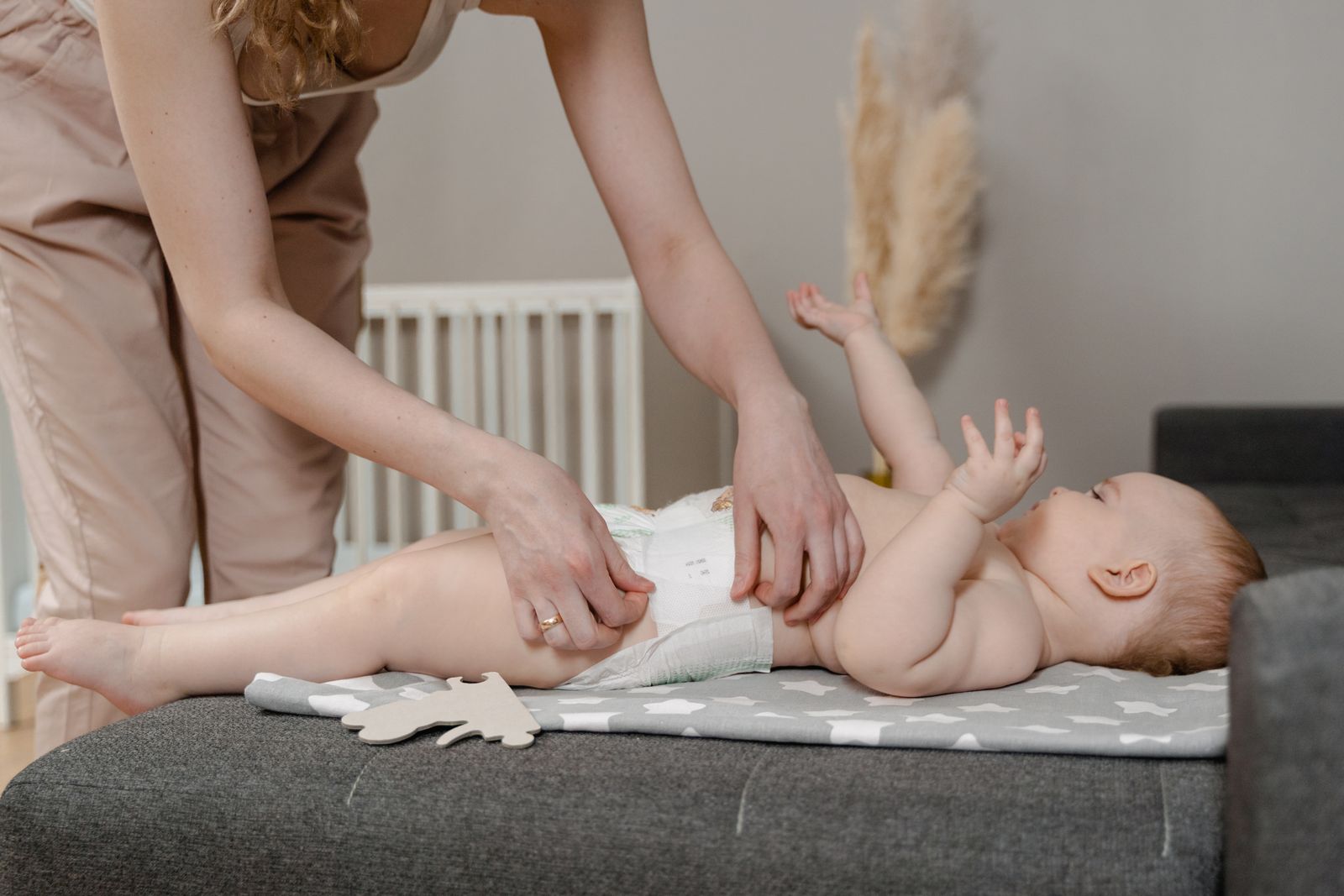
TL;DR
Most diaper rash is simple irritation from wetness, friction, and stool sitting against the skin, and it clears in about 3 days with frequent changes, air time, and a thick barrier cream. If the rash is still there after 3 days, is beefy red, sits in the skin folds, and has little red dots just outside the edge, it is probably yeast and needs an antifungal. In a breastfed baby, that yeast often travels between your nipples and your baby's mouth, so you both may need treating at the same time.
You open the diaper and your stomach drops. The skin is red, angry, maybe shiny, and your baby screams the second the wipe touches it. You feel like you did something wrong. You did not. Diaper rash is one of the most common things that happens to a baby’s skin in the first year, and most of the time it clears in about 3 days once you know what you are doing.
First, the part that will feel familiar. You have probably already changed brands, bought three different creams, and stood over the changing table at 2 a.m. wondering if you left a wet diaper on too long. Every mom does this. But here is the more useful question, and almost nobody asks it early enough: has this rash been here more than 3 days? Because that one detail changes the whole plan.
What diaper rash actually is
Most diaper rash is irritant contact dermatitis. That is a long name for skin that got worn down by sitting in a warm, wet, closed-up space.
Three things do the damage together. Wetness softens the skin’s outer layer so it loses its shield. Friction from the diaper rubbing against that softened skin scuffs it. And then stool arrives, which is the real troublemaker. Poop carries digestive enzymes that break down skin, and when pee and poop mix, they raise the skin’s pH and wake those enzymes up even more. That is why a rash blows up so fast after a poopy diaper sits for an hour, and why pee alone rarely does much on its own.
A plain irritant rash looks pink to red, a little shiny or chapped, and it sits on the parts that actually touch the diaper. The round of the bottom, the tops of the thighs, the lower belly. Here is the detail worth memorizing: it usually skips the deep creases, because the creases do not press against the diaper. Remember that, because in a minute it is going to tell you something important.
Rashes also spike at predictable moments. Any time your baby’s stool changes, the skin has to adjust. Diarrhea, a growth spurt with more frequent stools, a course of antibiotics, and especially starting solids, which changes stool acidity almost overnight. Teething gets blamed a lot too, and while teething does not directly cause a rash, the extra drool being swallowed can loosen stools, which does. If you are in that stage, the real signs are in teething symptoms and relief. The opposite end of that spectrum, baby constipation, can irritate the skin too, since a harder stool takes more straining and more wiping to pass.
The 3-day rule that tells you what you are dealing with
Here is the single most useful thing in this whole post.
Treat any new diaper rash as ordinary irritation for 3 days. Frequent changes, air time, a thick barrier. Most rashes will look noticeably better within 24 hours and be nearly gone by day 3.
If it has not improved by day 3, stop treating it like irritation. A rash that stays put, gets angrier, or looks worse despite good care has usually been taken over by yeast. Candida is a normal resident of the gut and the skin, and the warm, damp diaper area is exactly where it likes to move in. More cream and more diligence will not fix it, because the problem changed.
That distinction is where most moms lose 2 or 3 weeks. They stay in the barrier-cream loop, doing everything right, while the actual cause needs a completely different product.
How to tell a yeast rash from an ordinary one
You can usually spot the difference yourself before your pediatrician ever sees it.
A yeast diaper rash is:
- Beefy or fiery red, deeper and more intense than the pink of a plain rash
- Down inside the skin folds, the groin creases and thigh creases, rather than skipping them
- Sharply edged, with a defined, sometimes scalloped border instead of fading out gradually
- Ringed by satellite dots, small separate red spots or little pimples scattered on the skin just beyond the main patch
- Sometimes raw or weepy in the center
- Stubborn, still there after several days of good barrier care
Those satellite dots are the giveaway. An irritant rash has one blurry-edged patch. Yeast throws little outposts past its own border.
One more clue lives in the timing. Yeast rashes love to show up right after a course of antibiotics, whether your baby took them or you did. Antibiotics knock down the normal bacteria that keep yeast in check, and yeast fills the empty space.
The part nobody connects: your nipples

If you are breastfeeding and your baby has a yeast diaper rash that keeps coming back, look up.
The same candida can live in your baby’s mouth as oral thrush, pass through the gut, and come out in the stool, which is how it seeds the diaper area. And it can move the other direction too, from your baby’s mouth onto your nipples during feeds. Then the two of you hand it back and forth. You treat the bottom, it clears, and 10 days later it is back, because the source was never touched.
Signs the loop is running:
- On you: burning, stinging, or shooting pain in the nipple during and especially after feeds, nipples that look shiny, pink, or flaky, pain that does not match the latch
- On your baby: white patches inside the cheeks, on the gums, or on the tongue that do not wipe off, fussiness at the breast, plus that stubborn diaper rash
If any of that sounds like you, the pain deserves a proper look on its own. Nipple pain has more than one cause and they are treated very differently, which I walk through in sore nipples vs thrush.
Ask your provider to treat both of you at the same time. This is the part to say out loud at the appointment. Baby usually gets an antifungal cream for the bottom and often an oral gel or drops for the mouth. You get an antifungal cream for your nipples, and sometimes an oral medication if it is stubborn or deep. Treating one of you alone is how families end up in month two of the same infection.
And yes, you can keep nursing the entire time. Treatment is safe with breastfeeding, and most moms feel better within 2 to 3 days of starting. Keep using everything for several days after it looks clear, because stopping the moment it looks better is the most common reason it returns.
Track every feed without the spreadsheet
Latchly times each side, logs pumps, and shows you the patterns. Free to start.
7 fixes that actually work

1. Change more often than feels necessary. Every 2 hours during the day, and immediately after every poop, even if that means waking a napping baby for a stool. Time against the skin is the whole ballgame. Nothing else on this list matters as much.
2. Rinse instead of scrubbing. On raw skin, wipes hurt and drag. Use warm water and a soft cloth, or squeeze water from a peri bottle over the area. If you do use wipes, pick fragrance-free and alcohol-free ones. Pat dry, never rub.
3. Give the skin real air time. Lay your baby on a towel or waterproof pad with the diaper off for 10 to 15 minutes a few times a day. Dry, open air does something no cream can. Yes, there will be accidents. Put a folded towel under the mat and let it happen.
4. Put the barrier on thick. Zinc oxide or plain petroleum jelly, spread on like frosting, not rubbed in like lotion. You should not be able to see skin through it. The goal is a physical wall between skin and moisture so the skin can heal underneath.
5. Stop scrubbing the old cream off. At the next change, wipe away the soiled top layer and leave the rest. Scraping the barrier down to bare skin every time re-injures exactly what you are trying to protect.
6. Loosen the diaper and go up a size during a flare. A snug fit traps heat and moisture and rubs harder. A little slack at the waist and thighs lets air move. Skip plastic pants and tight covers until it clears.
7. Switch to an antifungal after day 3. If the rash fits the yeast picture, barrier cream alone will not clear it. Your pediatrician will point you to an antifungal cream, usually clotrimazole, miconazole, or nystatin, applied with each change. Put the antifungal on first, then the barrier cream over the top of it.
What to skip
Cornstarch. This one is worth being blunt about. Cornstarch is a carbohydrate, and yeast eats it, so you may be feeding the exact thing you are fighting. Loose powders can also be breathed in by a baby.
Talc powder. Same inhalation concern, and it does not treat anything.
Baking soda pastes. No good evidence, and it can sting and irritate skin that is already broken.
Drying it out with alcohol or witch hazel. Broken skin plus alcohol is just pain.
Hydrocortisone or leftover prescription creams. Do not use a steroid cream on your baby’s bottom unless your pediatrician told you to. Steroids can thin delicate skin and make a yeast rash worse.
Blaming yourself and changing everything at once. If you swap the diaper brand, the wipes, the detergent, and the cream all in one day, and it clears, you have learned nothing about what actually caused it.
When to call your pediatrician
Most diaper rash never needs an appointment. Call if you see:
- Blisters, pus, open sores, or bleeding
- A fever in your baby, and any temperature of 100.4F or higher in a baby under 3 months is a same-day call
- A rash spreading beyond the diaper area, onto the belly, back, or legs (a dry, itchy rash that shows up on the cheeks and body rather than the bottom may be eczema instead)
- Bright red skin with yellow crusting or streaks, which can point to a bacterial infection
- No improvement after 3 days of good home care
- A rash that keeps coming back within days of clearing
- Your baby seeming genuinely in pain rather than just annoyed during changes
If your baby is also having very few wet diapers alongside the rash, that is a separate thing worth checking, and how many wet diapers to expect will tell you what is normal for your baby’s age.
The thing I wish I’d known

A rash on your baby’s bottom feels like a public verdict on how well you are doing. It is not. Every baby’s skin sits in a warm, closed, damp space for a year, and skin was not designed for that. Rashes happen to attentive, careful, exhausted moms who change diapers at 3 a.m. and do everything right. The same goes for the baby acne that shows up on so many newborn faces around the same time. Newborn skin just does dramatic things, and none of it is a verdict on you.
What actually changes the outcome is not doing more. It is watching the clock. Give ordinary care 3 days. If the rash is still there, or it is beefy red and sitting down in the creases with little dots around the edge, stop repeating the same routine harder and get an antifungal into the picture. And if you are breastfeeding with burning nipples, say that in the same phone call, because the two things are usually one thing.
Tonight, do the simple version. Change more often, rinse instead of scrub, 10 minutes of bare-bottom time, and a thick layer of barrier cream at every change. Then mark the day on your phone. If you are on day 3 and it has not turned the corner, you already know your next move.
Frequently asked questions
How long does diaper rash take to clear up?
A plain irritant diaper rash usually looks better in 24 hours and is mostly gone in about 3 days with frequent changes, air time, and a thick barrier cream. If you are doing all of that and the rash is the same or worse on day 3, stop assuming it is ordinary irritation and check it for yeast.
How do I know if my baby's diaper rash is yeast?
A yeast rash is beefy or fiery red, sits down inside the skin folds instead of skipping them, has a sharp scalloped edge, and usually has small red dots or pimples scattered just beyond that edge. Those outlying dots are the giveaway. An ordinary irritant rash is pinker, more spread out on the flat skin, and tends to spare the creases.
Can my baby's yeast diaper rash give me thrush on my nipples?
Yes, and it works both ways. The same yeast can live in your baby’s mouth, come out in the stool, and land on your nipples during feeds. If you have burning or shooting nipple pain and your baby has a stubborn diaper rash, ask your provider to treat both of you at the same time. Treating only one of you usually means it comes right back.
Should I use cornstarch or baking soda on diaper rash?
No. Cornstarch actually feeds yeast, and loose powders can be breathed in by your baby. Baking soda has no good evidence behind it and can irritate raw skin. Stick with a thick zinc oxide or petroleum jelly barrier, which is what pediatricians actually recommend.
Can I keep breastfeeding while we treat thrush and a yeast diaper rash?
Yes. It is safe to keep nursing all the way through treatment for both of you. Most moms start feeling better within 2 to 3 days of starting an antifungal, though you usually need to keep using it for several days after everything looks clear so it does not come straight back.
When should I call the doctor about diaper rash?
Call if the rash has blisters, open sores, bleeding, or oozing pus, if your baby has a fever, if the rash spreads past the diaper area, or if it has not improved after 3 days of good home care. Also call if your baby seems to be in real pain rather than just fussy at changes.